


Most North American financial institutions now rely on an extensive ecosystem of third-party providers to deliver critical business capabilities across technology, data, cloud, operations, and customer support. This growing reliance has substantially increased the volume and strategic importance of spending managed through procurement. In our experience, roughly 40 to 50 percent of operating expenses at many banks flows through these external vendors and contractors, making third-party spending one of the largest controllable cost pools.
Yet procurement capabilities and investment have not kept pace with the growth and increasing complexity of this spending. Procurement has historically been perceived as a back-office function focused primarily on sourcing and contract administration. It has typically received less investment than customer-facing and revenue-generating functions, while leadership attention and transformation funding have often been directed toward growth, distribution, and customer experience initiatives.
Consequently, procurement’s mandate has remained largely focused on cost control and compliance. In the financial sector, unlike many others, institutions operate within highly regulated environments that require extensive third-party risk management, compliance reviews, cybersecurity assessments, and legal oversight. As a result, many institutions live with fragmented processes, limited spending transparency, and labor-intensive execution models.
The upside of getting procurement right is material. At many financial institutions, it shows up first in their day-to-day performance: Leading procurement teams consistently outperform peers, delivering 7 to 10 percent savings across addressable third-party spending, our case experience shows. Beyond savings, we have seen leading institutions accelerate their sourcing and contracting cycles, improve third-party onboarding, and strengthen their compliance with sourcing and risk management requirements. These improvements strengthen governance, increase transparency, and promote greater consistency across critical vendors and services.
The institutions that realize these gains will be those that reimagine procurement as a strategic business capability—modernizing spend management, embedding procurement more deeply in business and technology decisions, adopting AI-enabled execution, and investing in the capabilities required to sustain performance over time.
A new value imperative for financial institutions
Procurement’s importance is rising at a time when capital markets continue to value banking at a discount relative to many other industries, reflecting investors’ skepticism about the sector’s ability to generate sustained value creation (Exhibit 1). Looking ahead, further pressure on returns is expected to come from several structural headwinds, including more intense competition, ongoing macroeconomic uncertainty, and shifts in customer behavior.
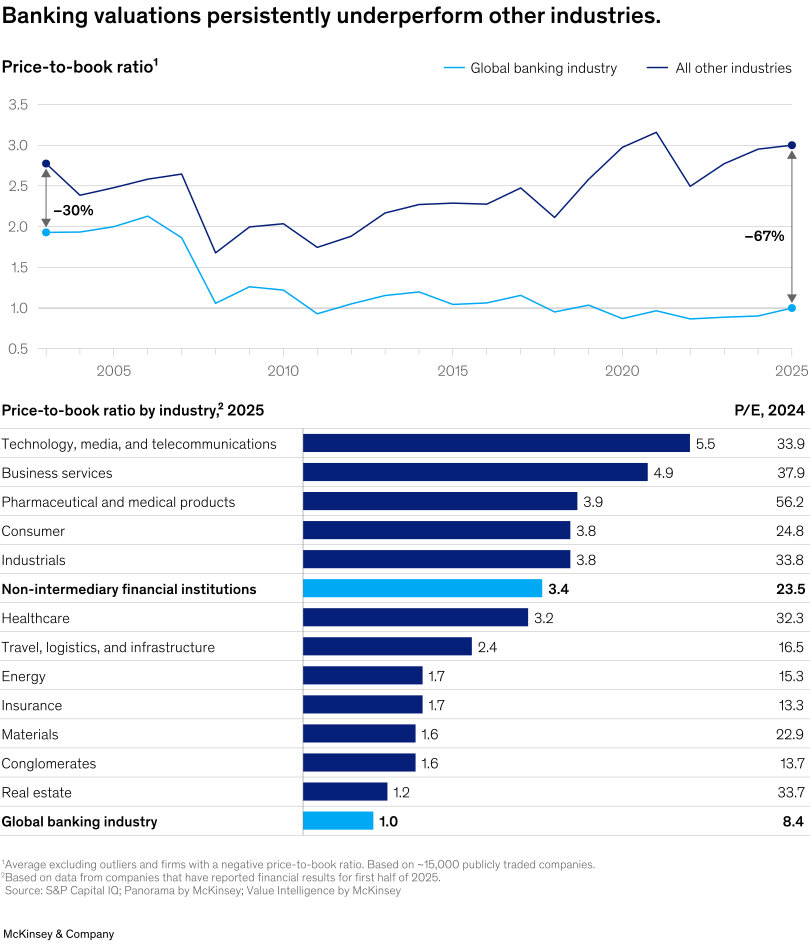
As a result, banks face a renewed imperative to improve productivity, optimize costs, and deploy capital more efficiently. They also need greater spending transparency, tighter governance, and more consistent execution across an increasingly complex third-party ecosystem.
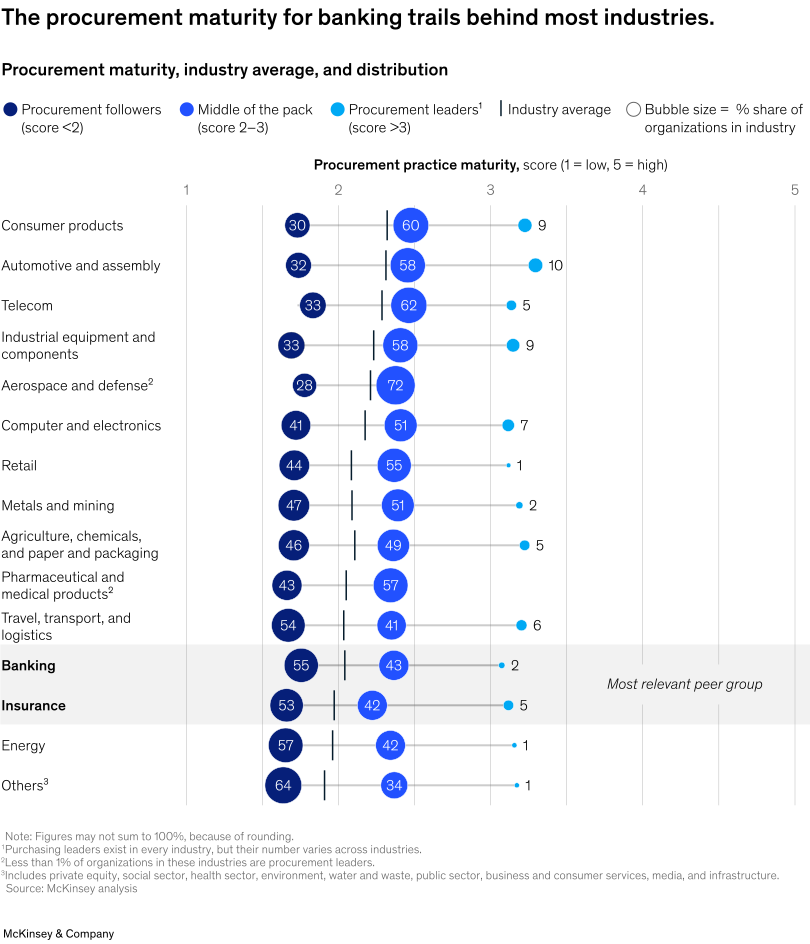
Procurement should be at the center of this effort. Yet banks trail most other industries in procurement practice maturity, as measured by the extent to which organizations have adopted leading procurement practices across the function (Exhibit 2). The resulting gap between banking and other industries reflects years of underinvestment as well as regulatory compliance processes that have often evolved in a fragmented manner, contributing to elongated cycle times and barriers to automation. Under these conditions many procurement organizations are left ill equipped to manage one of their institution’s largest and most strategic spending categories.
A playbook for a new era
To meet the challenge, chief procurement officers should focus on building their institutions’ capabilities across four key areas.
Strategic, comprehensive spending management aligned with business objectives
Leading organizations manage third-party spending as a portfolio, building multiyear category strategies for key financial services domains such as cloud, infrastructure, enterprise software, market data, cybersecurity, and external labor. Rather than relying on isolated sourcing events, these organizations use transparent spending data and pricing intelligence to directly advance enterprise priorities, such as cost reduction and regulatory resilience.
Critically, these organizations also strengthen demand management, which in our experience typically drives 30 to 40 percent of the value at stake. By actively shaping consumption and embedding “buying with intent” into early business decisions, they shift procurement from a reactive function to a strategic partner that steers commercial outcomes. In many institutions, the largest opportunities come not only from negotiating better rates but also from reducing unnecessary demand, rationalizing vendor usage, and optimizing consumption before money is committed.
A new business partnership operating model
The strongest procurement teams are shaping internal demand and partnering with the institution’s functions on supplier choices that affect delivery, resilience, and risk. Rather than operating in a silo, they embed procurement more deeply into business and technology decision making and elevate governance to ensure that procurement, finance, technology, and business leaders work in lockstep.
Many leading institutions are also adopting business-aligned relationship management models that provide a clear point of contact for stakeholders while improving visibility into future demand and sourcing priorities. In parallel, they manage strategic suppliers differently—with more rigorous performance management, executive engagement, and collaboration. Automation further accelerates this effort by moving transactional work to self-service pathways within defined guardrails.
AI-enabled execution
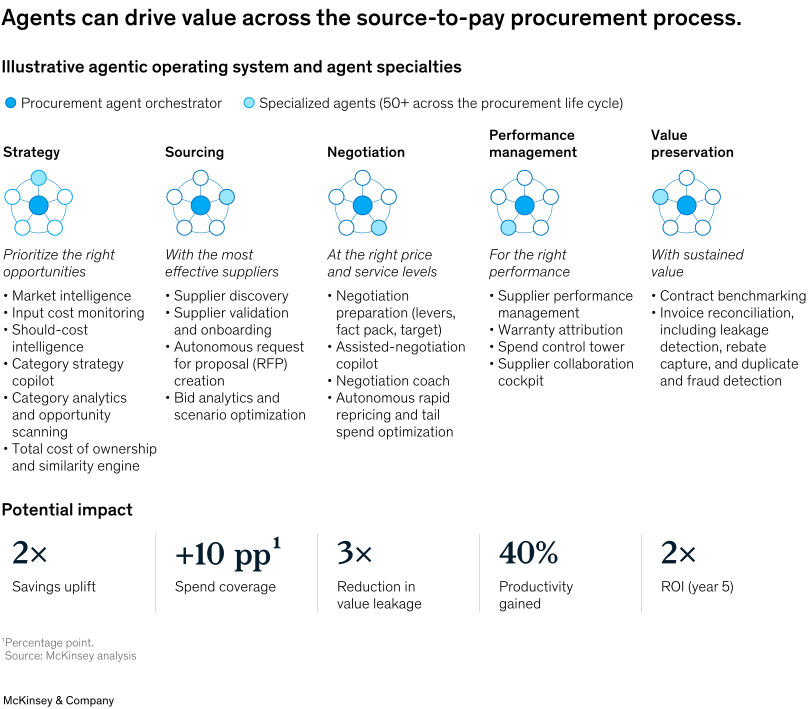
Agentic AI offers financial institutions a timely opportunity to help close the procurement maturity gap by shifting procurement and third-party management from manual, documentation-heavy execution to digitally enabled, end-to-end orchestration. Leading teams are already moving beyond isolated task automation, building AI-enabled digital backbones across the procurement process. They are focused on embedding AI into day-to-day execution to improve speed, consistency, and control in areas such as spending analytics, request-for-x (RFx) support, procure-to-pay processes, and supplier governance.
In the process, they are turning fragmented spending, supplier, and contract data into actionable insights while applying more consistent standards across a broader supplier base. For example, they can use market intelligence, input costs, and other data to source from the most effective suppliers—finding, validating, and onboarding new suppliers and then helping to negotiate the right price and service levels.
Our experience shows that, done well, agentic AI can unlock 25 to 40 percent efficiency gains across procurement activities and free up capacity for higher-value work, such as shaping demand, conducting strategic negotiations, managing supplier performance, and supporting the company’s business partnerships (Exhibit 3).
Talent upgrades and capability building
Procurement excellence in financial services increasingly requires a blend of category depth, analytics, commercial skills, risk fluency, and the ability to work with AI. As spending shifts further toward technology, data, cloud, and specialized services, leading institutions are therefore investing in deeper category expertise alongside broader business and analytical capabilities. They are hiring selectively from technology and other industries, building structured learning paths, and investing in retention and career progression so the organization can sustain performance over time. Talent remains one of the strongest predictors of procurement outcomes, according to our research, and capability building is often the difference between a one-time savings program and a lasting step change in performance.
What’s at stake
Procurement, once viewed as a back-office cost control function, is increasingly becoming a strategic capability for financial institutions. As banks navigate margin pressure, technology disruption, and a deep reliance on third-party providers, it can no longer be treated as an administrative function.
Institutions that modernize procurement will not only unlock meaningful cost savings but also strengthen resilience, accelerate execution, and improve their performance in one of their largest spending categories. In an increasingly externalized operating model, procurement may become one of the most important drivers of enterprise productivity and value creation.