Life sciences companies face growing pressures that demand new approaches to growth, productivity, and agility. Agentic AI has the power to enable a reimagination of the entire life sciences value chain. In pharmaceuticals, 75 to 85 percent of workflows can be enhanced or automated by AI agents, note Partner Eoin Leydon and coauthors. For example, clinical trials could become faster, more efficient, and of better quality with improved patient experiences. As AI evolves into an intelligent collaborator capable of operating semiautonomously, it could boost clinical development productivity within five years by 35 to 45 percent, benefitting all functions.
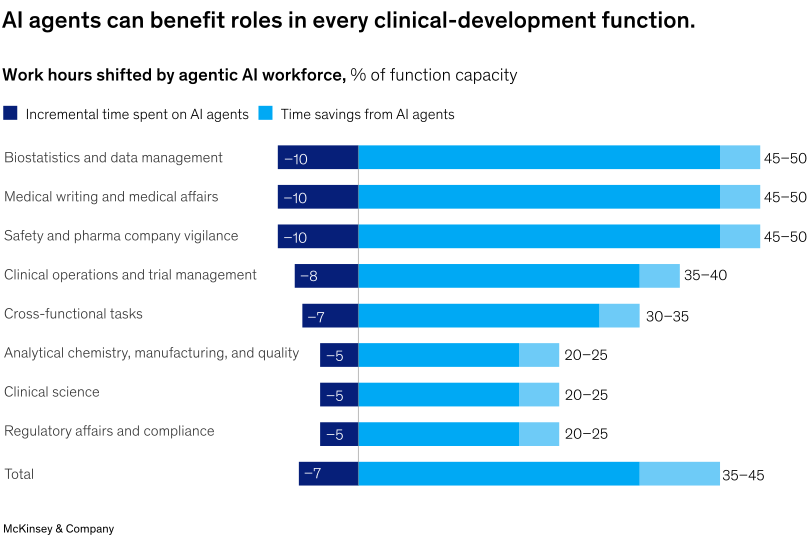
Image description.
A horizontal stacked bar chart illustrates the impact of an agentic workforce on various clinical development functions, showing the percentage of function capacity shifted by work hours. The chart is divided into eight categories: Biostats and data management, Medical writing and medical affairs, Safety and pharmaco vigilance, Cross-functional, Clinical operations and trial management, Clinical science, Regulatory affairs and compliance, and Analytical chemistry, manufacturing, and quality. Each category has two bars, representing "Incremental time spent on agents" (dark blue) and "Time savings from agents" (light blue). The chart shows that across all categories, the time savings from agents outweigh the incremental time spent on them. For instance, Biostats and data management has a -10% incremental time spent and a 45-50% time savings. The total average shows a -7% incremental time spent and a 35-45% time savings. Other notable categories include Medical writing and medical affairs, and Safety and pharmaco vigilance, both with -10% incremental time and 45-50% time savings. The chart effectively demonstrates that the benefits of an agentic workforce are evident across various clinical development functions.
This image description was completed with the assistance of Writer, a gen AI tool.
End of image description.
To read the article, see “Reimagining life science enterprises with agentic AI,” September 8, 2025.