







The race to build AI infrastructure generally has been led by those who have access to chips or servers. In Asia–Pacific (APAC), however, that is changing. What increasingly matters is securing power and land, navigating permits, and bringing AI-ready capacity online quickly. In many markets across the region, colocation providers (colos) are no longer just builders of facilities that support the AI boom—they are becoming the operating layer and institutional vehicle through which hyperscalers grow.
The race for physical resources
The AI infrastructure supercycle has pushed the focus of competition beyond software into physical capabilities. Power, land, and speed are the factors that now shape who can scale and where.
In North America, the largest hyperscalers have moved fast toward self-build.1 Owning the site, design, and infrastructure stack gives them tighter control over capacity, network architecture, and operating standards. On the other hand, build-to-suit colocation—where a provider develops and operates a facility tailored to the specifications of an anchor tenant—remains a key part of the colocation value proposition, as it delivers customized infrastructure without requiring customers to own the asset. Build-to-suit colocation still matters, but for the largest AI deployments, it is often a complement rather than the default model.
APAC operates differently. Instead of being one big national market, it faces a localized supply ecosystem and a complex contextual regulatory landscape. With mounting pressure for fast build-out to meet rising demand, these challenges make it difficult for hyperscalers to self-build.
In light of the differing markets in APAC, colos in the region have emerged as critical partners that are expected to use their expertise in location, electricity, talent, and construction to help deliver AI infrastructure for hyperscalers and enterprises. Hyperscalers still define the technical requirements and commit the demand, but the physical build-out increasingly runs through specialist operators that control access to land, power, permitting, and delivery. Our research indicates that colos could build more than 70 percent of the data center capacity to serve regional demand by 2030 (Exhibit 1).2
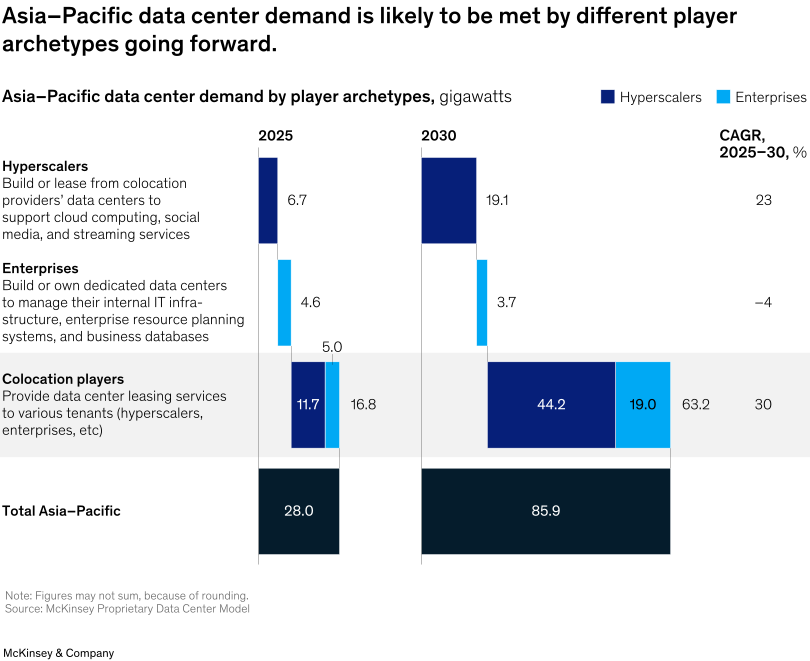
Meanwhile, market constraints are accelerating. JLL reports that approximately 78 percent of the data center construction pipeline in APAC is already precommitted up to 2027, with vacancy rates about 7 percent.3 In this highly competitive landscape, waiting is a liability. Customers are going to have to anticipate their future requirements and lock in capacity early to guarantee availability and manage long-term costs.4 This points to not just an operation model shift, but more important, to revenue visibility and project financeability for colo operators.
In Mainland China, the model is even more pronounced. The use of local colos for both hyperscalers and enterprises is reinforced by regulatory requirements, power allocation processes, and local operating complexity.
Across Southeast Asia and the rest of APAC, the same logic holds for a different reason. Regional colos such as AirTrunk, DayOne, Bridge Data Centres, Princeton Digital Group, and STT Global Data Centres already have local presence, utility relationships, and execution capabilities on which hyperscalers rely to expand quickly.5
Therefore, the center of gravity for APAC data center builds sits with the colo model. Hyperscaler demand does not automatically translate into infrastructure built and owned by hyperscalers; more often, it results in build-to-suit or leased capacity delivered by a colo partner. In APAC, colos are the institutional vehicle through which AI infrastructure is being financed and scaled.
The DNA of Asia–Pacific colos: More than real estate
Colos in APAC have always leased out space, but their role has evolved—now they solve the hardest parts of deployment in markets where those constraints determine whether a project moves forward at all.
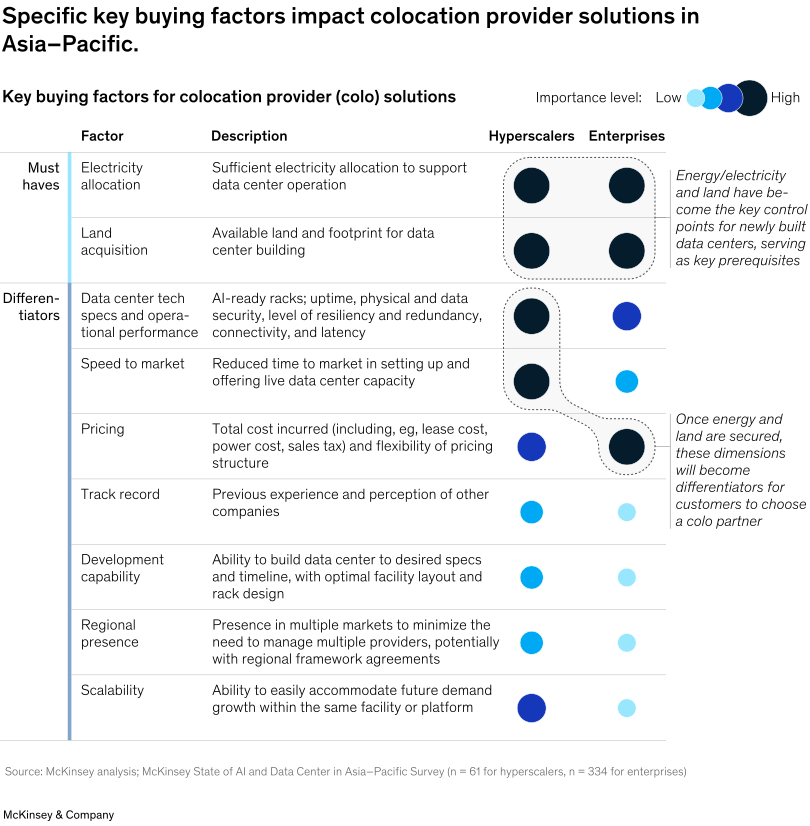
At the most basic level, leading colos control the prerequisites for new capacity: electricity allocation, land acquisition, the ability to navigate through local approvals, and the talent to support the build-out. In many APAC markets, these are the real bottlenecks in AI infrastructure build-out. Colos’ new operating role gives them influence that extends well beyond real estate, as colos increasingly codesign facilities with tenants, shape site specifications, and determine how quickly a project can develop from contract signature to live capacity.
For example, Bridge Data Centres helped ByteDance deliver the first phase of a data center in Johor, Malaysia, in under a year, using its Prefabricated, Prefinished Volumetric Construction (PPVC) modular-building construction technique and modules that had been prefabricated in China.6
This influence is reinforced by data-localization rules, licensing structures, and domestic operating requirements. In APAC, the operator is often central not just to delivery but to market access itself (Exhibit 2). Electricity and land are the table-stakes requirements; once those are secured, the differentiators shift to technology and AI-readiness, speed to market, pricing, and development capability.7 Operators now offer capacity as well as execution certainty.
In the rest of APAC, the role is shaped more by fragmented permitting regimes, utility connection processes, and fast-moving demand corridors, such as Jakarta in Indonesia, Johor in Malaysia, Chonburi in Thailand, and other emerging hubs. The specifics differ, but the practical result is similar: Hyperscalers move faster when a strong data center operator sits at the center.
Extended influence: Colos are reshaping the vendor landscape
As colos take on a larger share of the build-out, they gain greater influence over procurement, especially for nonserver infrastructure. In many APAC projects, hyperscalers still set the core performance requirements, but colos now play a much larger role in translating those requirements into vendor choices across power, cooling, electrical systems, and general infrastructure.
In Mainland China, this influence is particularly visible in power, cooling, and other facility systems where domestic qualification, local integration, and execution certainty matter as much as the equipment itself. In contrast, the dynamic across the rest of APAC is often less about localization and more about speed, standardization, and the operator’s preferred build model. Even so, the commercial logic is similar: Vendors increasingly need to win with the colo as well as the end customer.
This shift matters because AI data centers are becoming more integrated at both facility and rack levels. Decisions on liquid cooling, power architecture, and deployment sequencing now directly affect the speed, cost, and operability of the entire site.
A practical consequence is that even if a vendor can meet a hyperscaler’s high technical bar, it still has to align with the colo’s preferred design, procurement model, or implementation sequence (Exhibit 3). Given this, the route to market for many infrastructure categories in APAC—from design and power to electrical and general infrastructure equipment—increasingly runs through colos.
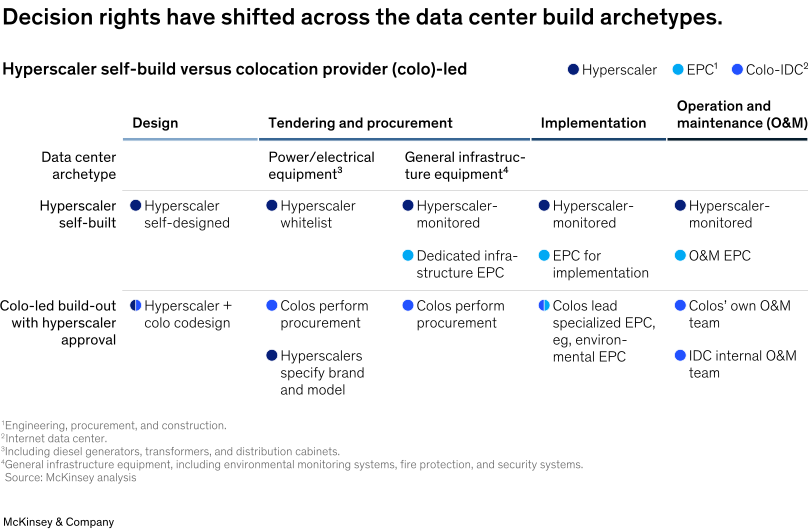
The decision rights have shifted across build models. In self-build environments, the hyperscaler retains far more direct control, while in colo-led models, design, procurement, implementation, and operations are shared or led by the colo operator. In APAC, colos now play a direct role in shaping the supply chain rather than simply delivering capacity. Hyperscalers still control architecture, performance standards, and approved equipment vendors; colos, however, increasingly control site access, execution sequencing, and speed to capacity.
Strategic implications for equipment suppliers, hyperscalers, and investors
The changes in decision rights have an impact on enterprises across the value chain.
For infrastructure equipment suppliers, the route to market in APAC is increasingly colo-led, especially in power, cooling, and adjacent facility systems. Product merit alone is not enough to become a leader in the market. It may require deeper partnerships with hyperscalers as well as colos, earlier involvement in design cycles, and a stronger local execution footprint.
For hyperscalers in APAC, speed increasingly comes from orchestration rather than ownership. Working with the right colo can allow a hyperscaler to focus capital and engineering resources on the parts of the stack that truly differentiate it, while relying on a specialist partner to solve land, power, approvals, and delivery requirements. Some control is ceded, but time to capacity can improve materially.
For colos, the critical levers are to accelerate land and power acquisition by proactively securing access to powered land upfront. Colos can also consider building technological moats, such as having a talent bench in addition to using advanced engineering, deploying liquid cooling, and establishing energy independence. Monetizing green energy access for sustainable AI infrastructure and following certain regulations (such as environmental approvals, building permits, and data sovereignty) could be an added advantage.
For investors and ecosystem enterprises, APAC colos are key strategic control points in the AI value chain. They sit at the intersection of demand visibility, infrastructure execution, and vendor selection. This gives colos a greater central role in value creation than their traditional infrastructure builder label suggests. Capital is already scaling behind colos not only with resources but also healthy build-out pipeline and capabilities to shorten time to market. For example, AirTrunk was valued at AU $24 billion (US $16.1 billion) when Blackstone and CPPIB acquired the company in September 2024.8 In February 2026, ST Telemedia Global Data Centres was valued at approximately $13.8 billion Singapore dollars (about US $10.9 billion) when KKR and Singtel moved to full ownership.9
The new power center in APAC infrastructure
The APAC AI infrastructure build-out is not following the North American script. Physical constraints are tighter, local execution matters more, and the operating environment is more fragmented. As a result, colos are evolving from space providers into broader infrastructure partners through which AI infrastructure is being financed and scaled.
Enterprises that prosper in APAC are likely to be the ones that understand where control really sits in the regional build-out model and position themselves accordingly—and this means recognizing the strategic role that colos now play.
The authors wish to thank Alan Wang, Daniel Eisenberg, Debbi Cheong, Inji Yeom, Ivfen Foong, Joseph Soh, Sanika Shah, Sulovna Susant, Xiaolu Xu, and Zu Kai Choo for their contributions to this blog.
1 See, for example, among others: Matt Vincent, “Amazon doubles down on AI infrastructure with $30B in new US data center infrastructure investments,” Data Center Frontier, June 10, 2025; Microsoft Blog, “The golden opportunity for American AI,” blog entry by Brad Smith, January 3, 2025; “How Google is investing to accelerate innovation for the US,” Google, August 27, 2025; McKinsey Proprietary Data Center Model.
2 McKinsey Proprietary Data Center Model.
3 Andrew Batson and Jitesh Karlekar, Asia–Pacific data center report year-end 2025, JLL, March 10, 2026.
4 Kimberly Steele, “Global data center sector to nearly double to 200GW amid AI infrastructure boom,” JLL press release, January 6, 2026.
5 For further information, see airtrunk.com; bdxworld.com; dayonedc.com; gds-services.com; princetondg.com; and sstelmediagdc.com.
6 “Bridge Data Centres and Bytedance celebrate grand opening of the first phase hyperscale data centre (MY06) in Johor, Malaysia,” BDC press release, October 21, 2022; “Building a modular hyperscale data center in Malaysia,” DCD, December 19, 2022.
7 AI-ready racks are expected to shift from 10–20 kW to 40 to 300 kW and up to 600 kW racks by second half of 2027. Sebastian Moss, “Nvidia’s Rubin Ultra NVL575 rack expected to be 600kW, coming second half of 2027,” DCD, March 18, 2025.
8 “Blackstone announces agreement to acquire AirTrunk in A$24B transaction,” Blackstone, September 4, 2024.
9 “KKR-led group set to buy ST Telemedia Global Data Centres,” Communications Today, February 2, 2026.