







In the Asia–Pacific (APAC) region, AI demand is shifting from a spillover market to a regional one, with growing local demand and increasing digitization across industries. This is attracting both Eastern and Western hyperscalers, affecting where investment is targeted and infrastructure is built.
Demand is broadening, not just shifting
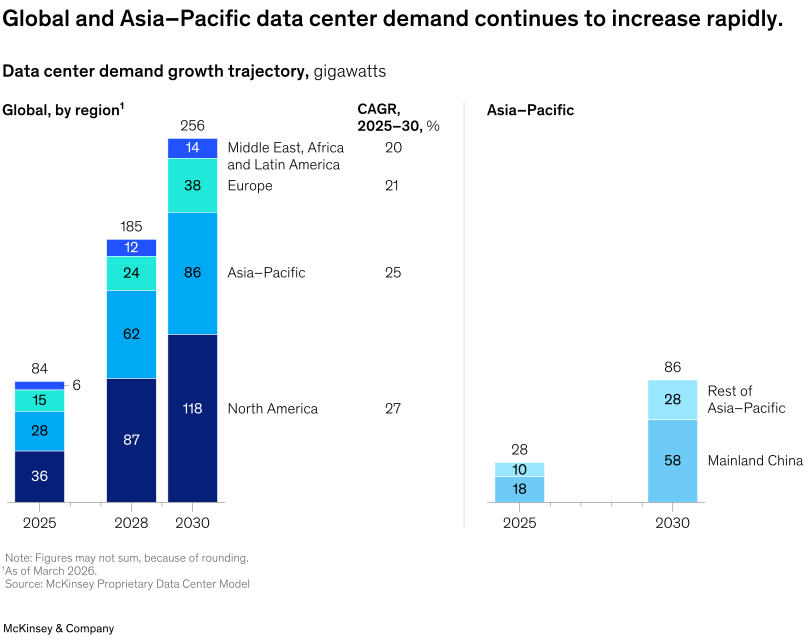
McKinsey research reveals that data centers could need about $6.7 trillion in cumulative capital investment across the global data center value chain between 2025 and 2030 to keep pace with increasing demand.1 North America remains the largest market, but APAC is rapidly becoming a major growth engine. By 2030, APAC could account for roughly 34 percent of global data center demand, in contrast with about 46 percent for North America.2
According to a McKinsey survey of APAC hyperscalers and enterprises conducted in September 2025, the main source of data center demand for APAC has been traditional compute, storage, and cloud—comprising over 70 percent of workloads.3 AI training and inference have contributed around 30 percent. That is changing: Demand is increasingly emerging from local AI adoption and a broader enterprise digitization cycle, especially in sectors such as manufacturing, retail, and fintech, supporting a more durable demand mix, with roughly a 50-50 split between AI and traditional workloads by 2030.
To support APAC demand, the top Western hyperscalers and cloud providers—Amazon Web Services (AWS), Google, Microsoft, and Oracle—have committed investments of over $160 billion from January 2024 to May 2026 to build AI infrastructure in the region, based on McKinsey research.
Asian enterprises are also joining the game. Chinese cloud giant Alibaba announced in February 2025 that it would invest at least $52 billion in cloud and AI infrastructure globally over the next three years, and Bytedance may spend approximately $30 billion on AI infrastructure in 2026 alone.4
In Southeast Asia, Alibaba Cloud opened a second data center in Thailand in 2025, explicitly citing rising demand tied to generative AI and customers in sectors such as fintech, retail, and technology.5 Across Asia more broadly, banking and financial services, technology, and digital native industries are leading, deploying, and scaling value, creating AI applications for agentic use cases in operations, customer service, and decision-making.
Regional demand patterns differ within APAC itself
Mainland China remains the largest market within this regional story. It could account for more than 70 percent of APAC demand by 2030, approximately 58 gigawatts (Exhibit 1).
Its market operates on a fundamentally different logic from that of North America, characterized by a complex interplay of domestic substitution and selective global collaboration. Understanding this dual-track evolution—the acceleration of local value chains and the enduring opportunities for foreign capital and technology—is essential for decoding the true potential of the AI boom in APAC.
Outside Mainland China, specifically in East and Southeast Asia, growth is further being fueled by a mix of Eastern and Western stacks and sovereign digital agendas, resulting in new growth corridors such as in Johor in Malaysia, Chonburi in Thailand, Jakarta in Indonesia, Mumbai in India, and Osaka in Japan. Demand is being shaped by both regional expansion from Western cloud providers (70 percent of hyperscaler demand), as well as deployments associated with Chinese cloud and platform companies (30 percent of hyperscaler demand). For instance, AWS has invested $15.5 billion in expanding its Osaka and Tokyo data centers.6 Alibaba continues to grow its footprint in Southeast Asia (in Malaysia and the Philippines, for example) to support its expansion under high-end chip constraints.7 ByteDance is the anchor tenant to many data center colocation facilities in Southeast Asia, too.8
Across markets such as Australia, India, Japan, and Southeast Asia, sovereign priorities and in-country cloud expansion are adding a broader base of demand beyond hyperscaler spillover. Singapore is treating AI as a national capability, rather than a narrow technology initiative. Under the National AI Strategy 2.0 (NAIS 2.0), updated in May 2026 and now steered by a council chaired by the prime minister, the country is proactive in AI adoption across government, enterprises, and priority sectors. In conjunction, it is investing in talent, trustworthy AI governance, and local and regional AI capabilities.9 In January 2026, the Singapore government made an additional 1 billion Singapore dollar (about US $786 million) investment over five years under the National AI Research and Development Plan, which supports NAIS 2.0 and other AI research efforts.10 In Japan, the government launched its AI Bridging Cloud Infrastructure, ABCI 3.0, as a core national sovereign AI supercomputer to enhance AI sovereignty, backed by an investment of 36 billion yen (US $232 million).11
Mainland China is localizing fast, while some parts of the value chain remain open
The APAC data center value chain still spans the familiar layers of energizers: upstream companies that provide energy, connectivity and power, cooling and networking equipment; designers and manufacturers (such as IT hardware and component suppliers); and downstream operators and end users such as hyperscalers, colocation providers, and enterprise users.
What is changing, however, is the degree to which those layers are being reshaped. In Mainland China, localization is moving beyond end demand into the upstream technology stack from cooling and power systems to servers and networking, and, increasingly, AI chips (Exhibit 2).
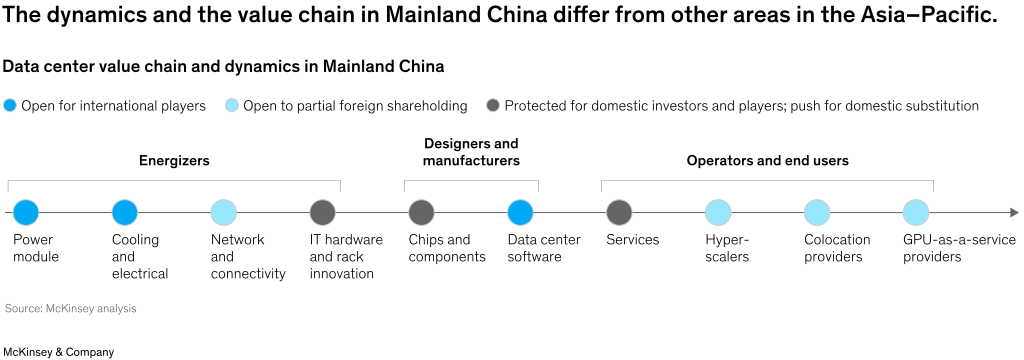
This localization push in equipment is accelerating because policy, capital, and supply chain resilience now reinforce one another. Chinese companies already lead in much of the domestic value chain, and momentum is building in the remaining white spaces. In cooling and electrical systems, for example, Envicool has officially been recognized as the first partner in Intel China’s Data Center Liquid Cooling Innovation Acceleration Program, and its Universal Quick Disconnect (UQD) and Multi Quick Disconnect (MQD) products have been listed as one of NVIDIA’s MGX ecosystem partners.12
In chips, the push is even more visible as national policy and procurement priorities accelerate local substitution. Huawei is estimated to ship roughly 750,000 units of Ascend AI chips in 2026, while Biren Technology continues to push further into validation and deployment with local users. China Mobile (the Biren 166 series) is one such example.13
Even so, the Mainland China data center value chain is far from a closed market—the more accurate description is that it is a market with selective openness to different aspects of the supply chain. Some downstream segments continue to include cross-border investment participation, particularly through listed operators and strategic shareholdings. For instance, STT Garnet is one of GDS’s shareholders, underscoring the fact that where the model, governance, and access points are right, international capital remains active.14
The same nuance applies to technology players. In the parts of the stack where performance and efficiency still matter more than origin alone, the market remains competitive. Power modules, cooling systems, and selected electrical equipment are still contestable for non-Chinese organizations that can deliver on efficiency, reliability, and integration. This is where foreign players still have credible room to compete, particularly where customers value differentiated power density, cooling performance, or system reliability. For example, Schneider Electric, Siemens, and Vertiv are active in this domain and own meaningful shares in related spaces. The opportunity set is narrowing into specific pockets rather than disappearing altogether.
Strategic implications for organizations in the value chain
The rising data center demand in APAC has ramifications for players across the value chain.
For equipment suppliers, getting ahead in APAC will depend on remaining alert to where standards are being set—tracking the latest shifts in cooling, high-density power, and adjacent infrastructure while staying close to the enterprises turning those requirements into live deployments. In Mainland China, that includes Chinese hyperscalers as well as colos. For the rest of APAC, equipment suppliers need to keep a close eye on both Eastern and Western hyperscalers and their colo partners. For suppliers with technological leadership (especially in power modules and cooling components), the edge may come from knowing where the next spec is maturing and deploying associated engineering and partnership resources early.
For hyperscalers and colos, the opportunity is to deepen their roles as the region’s standard setters. They can build localized ecosystems with real technological depth—qualified local suppliers, infrastructure partners that can codesign for local conditions, and operating models that can keep pace with demand. The advantage is not just faster build-out, but greater influence over vendor road maps and deployment standards.
For investors, the implication is to look beyond demand and focus on control points that are both compliant and accessible. One area of particular interest may be with leading hyperscaler and colo platforms in APAC and Mainland China, because these operators combine demand visibility, execution capability, and vendor influence. The investment logic is straightforward: back the platforms that are best positioned to turn demand into capacity, and capacity into a sustained ecosystem advantage. At the same time, strategic investments across the equipment supply chain that are potential chokepoints—from power cooling, networking—have become an area of interest for investors.
Asia–Pacific is the next engine of global demand
The APAC region is emerging as a demand market in its own right. Rather than simply absorbing spillover from the West, it is building its own growth engine, with Mainland China as the largest market, along with Australia, India, Japan, Singapore, South Korea, and the rest of the region adding breadth through new cloud regions, sovereign priorities, and AI-linked enterprise demand. As a result, APAC is starting to shape the next phase of infrastructure deployment on its own terms.
For investors, operators, and equipment companies alike, the implication is straightforward. The APAC region cannot solely be viewed through a simple China-and-the-rest lens. Some parts of the value chain are localizing quickly, some remain open to global capital and technology, and others, especially the colo and downstream operator layers, are emerging as the main control points through which demand could be captured.
Organizations that recognize these shifts early and move with precision will most likely take the lead in the market. In the APAC region, success may come less from treating the region as a spillover market and more from knowing where demand is becoming structural, where localization matters most, and where control over deployment is beginning to concentrate.
The authors wish to thank Alan Wang, Daniel Eisenberg, Debbi Cheong, Inji Yeom, Ivfen Foong, Joseph Soh, Sanika Shah, Sulovna Susant, Xiaolu Xu, and Zu Kai Choo for their contributions to this article.
1 “The cost of compute: A $7 trillion race to scale data centers,” McKinsey Quarterly, April 28, 2025.
2 McKinsey Proprietary Data Center Model.
3 McKinsey Hyperscalers and Enterprises in Asia–Pacific Survey (n = 61 for hyperscalers and n = 334 for enterprises).
4 Georgia Butler, “Alibaba Cloud reaffirms $52.7 bn global buildout plans,” DCD, May 27, 2025; Coco Feng and Ben Jiang, “Bytedance raises 2026 capex by at least 25% amid AI boom, rising memory costs, sources say,” South China Morning Post, May 9, 2026.
5 “Alibaba Cloud establishes second data center in Thailand with richer product portfolio for generative AI and industry-specific solutions,” Alibaba Cloud press release, February 13, 2025.
6 Hazel Moises, “AWS invests $15.5 billion in Japan for data center boost amid AI surge,” w.media, January 19, 2024.
7 “Alibaba Cloud boosts AI presence in Southeast Asia with new data centers,” Open Tools, July 2, 2025.
8 Dan Swinhoe, “Bridge Data Centres launch new facility in Johor, Malaysia,” DCD, October 20, 2022; “Scrutiny over ByteDance data centres, FT reports,” Private Market Insights, February 12, 2025; Dan Swinhoe, “AirTrunk secures $1,75bn green loan to fund data center development in Singapore,” DCD, August 18, 2025.
9 For further information, see “National AI Strategy,” smartnation.org.sg.
10 “Singapore invests over S$1 billion in National AI Research and Development plan to strengthen AI research capabilities and our position as a global AI hub,” Singapore Ministry of Digital Development and Information press release, January 24, 2026.
11 Nvidia Blog, “Japan enhances sovereignty with advanced ABCI 3.0 supercomputer,” blog entry by Dion Harris, July 11, 2024; Takihiro Takenouchi, “Supercomputer ‘ABCI 3.0’ to open new doors for AI research,” Asahi Shimbun, January 21, 2025.
12 “China’s Envicool’s 2025 revenue breaks CNY 6 billion for first time, AI data center liquid cooling demand becomes core growth engine,” Biggo Finance, April 26, 2026.
13 Alius Noreika, “Huawei Ascend 950 orders surge as DeepSeek V4 drives Chinese cloud giants to buy,” Technology Org, April 29, 2026; “BIREN TECH takes lead in completing pre-adaptation of China mobile Juitian 35B large model,” AA Stocks, April 27, 2026.
14 “GDS announces results of extraordinary general meeting and of additional shareholders meeting,” GDS, March 10, 2026.