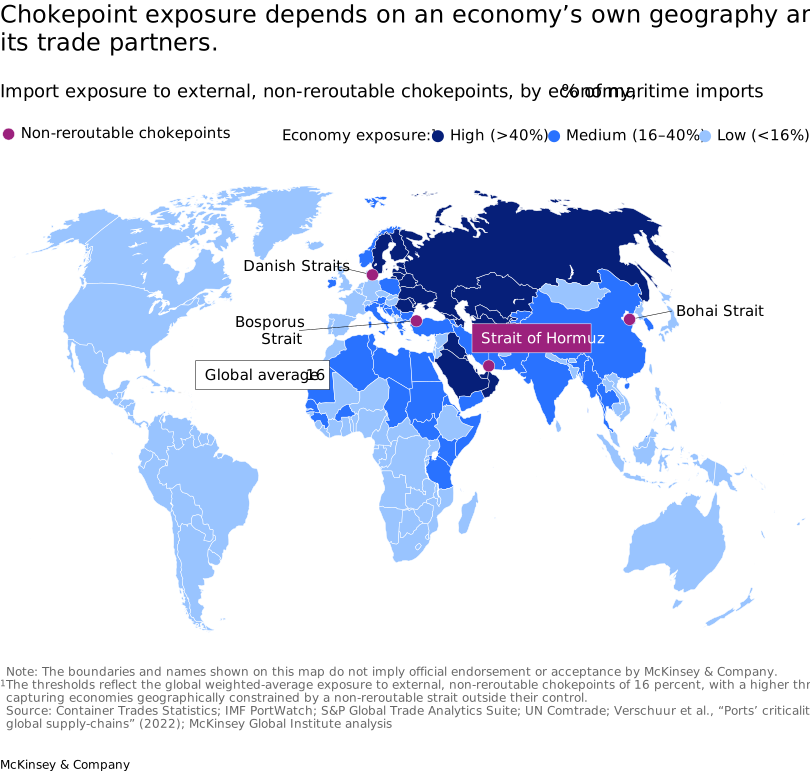
Global trade has proven resilient to geopolitical and economic shocks, but roughly one-quarter of global imports have structural vulnerabilities that could cause disruption. These risks are amplified when trade must pass through maritime chokepoints that cannot be bypassed, McKinsey Global Institute’s Jeongmin Seong, Tiago Devesa, Nick Leung, Shubham Singhal, and coauthors explain. Ukraine, for example, has 84 percent of its seaborne imports exposed to trade vulnerabilities. But an economy does not need to be located near a non-reroutable passage to depend on one: India, for instance, relies heavily on Persian Gulf economies for energy resources through its suppliers. To address trade vulnerabilities, economies could draw on six resilience levers—rearrange, relocate, ramp up, reserve, reduce, and rally—or a mix, depending on the product, the economy’s capabilities, and the potential consequences of a supply disruption.
Image description:
World map showing economies’ exposure to external, non-reroutable maritime trade chokepoints, measured as a percentage of maritime imports. Countries are shaded in three levels of exposure: dark blue for high exposure above 40%, medium blue for 16–40%, and light blue for low exposure below 16%. The global average is 16%. High exposure is concentrated in Russia, parts of Eastern Europe, Central Asia, and the Middle East, while much of the Americas, Western Europe, sub-Saharan Africa, and Oceania have lower exposure. Five non-reroutable chokepoints are marked in purple: the Danish Straits, Bosporus Strait, Strait of Hormuz, Bohai Strait, and a fifth point near the Strait of Hormuz region. The map illustrates how an economy’s exposure depends on both its own geography and that of its trading partners.
Source: Container Trades Statistics; IMF PortWatch; S&P Global Trade Analytics Suite; UN Comtrade; Verschuur et al., “Ports’ criticality in international trade and
global supply-chains” (2022); McKinsey Global Institute analysis
End of image description