
Asset managers face a significant challenge: Their technological setups no longer support their ability to enable growth, meet client needs and regulatory requirements, or satisfy their appetite for risk. Additionally, swiftly rising costs across the industry pressure asset managers to establish a central authority over the geographic and otherwise decentralized components of their IT operating models.
To overcome these challenges and modernize their technological legacies, many asset managers have initiated large-scale, multiyear technology transformation programs—some of which have catalyzed business transformation. According to McKinsey’s 2024 Ignite Survey, these concurrent transformations can increase run-the-bank efficiency by 30 percent, improve strategic flexibility, and derisk operations and future changes to IT.
But many asset managers struggle to bring business and technology together for this kind of project. IT often fails to convince the business side of the immense value of a technology transformation, partly because of the equally immense cost of such a venture, which can lead to abrupt endings and large write-offs. For its part, the business side is often reluctant to give up complex, costly, and unjustifiable customizations on top of the IT platform, because these functionalities support business-specific processes and increase revenue. In addition, both sides often resist setting up a global operating model before initiating a technology transformation, despite the expensive customizations that would be necessary for different countries.
From our work with asset managers, we have observed that only a collaborative approach between business and IT can drive technological transformation. In this post, we discuss the critical components asset managers need for a successful technology transformation. Asset managers that achieve this holistic approach could optimize their operations and deliver value efficiently across international markets.
Critical actions for technology transformation in asset management operations
Asset managers need to ensure that their technology transformation is not only effective but also aligned with the organization’s long-term objectives. Three critical actions—establishing a global operating model, managing business-side customizations, and implementing differentiated scope management—are integral to achieving a successful technology transformation in concert with a streamlined, agile operating model.
Creating an agile operating model aligned with global value streams
We’ve observed two main reasons that asset managers may not prioritize a global operating model at the start of a technology transformation. First, they mistakenly believe the global operating model will happen on its own. Second, they think it is too difficult to set up right away and instead decide to implement it later in the technology transformation. On the contrary, implementing a global operating model after the IT platform would be extremely costly and difficult because of the need for extensive country-specific customizations (exhibit).
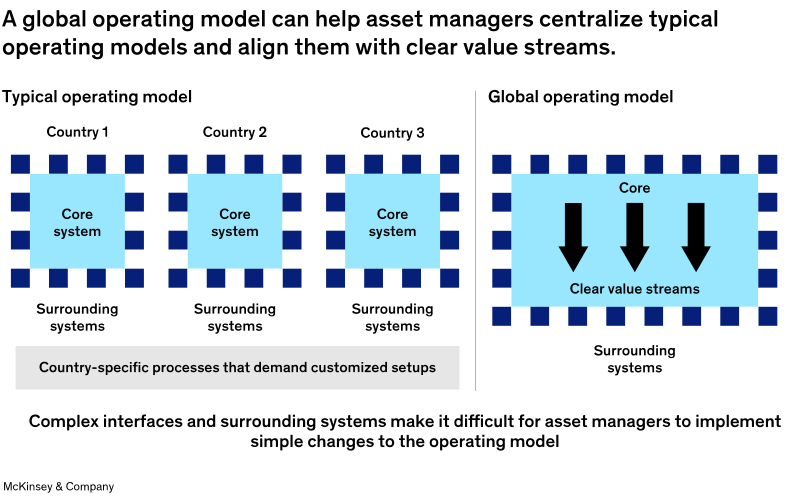
Asset managers that align their global operating model with agile principles along clear value streams ensure that stakeholders know their roles and responsibilities as well as the potential benefits to their functional areas. We’ve observed that clarifying these roles early on helps persuade the business side to adopt their roles. Simultaneously, functionalities in IT systems across value chains and end-to-end accountability for platform delivery need to be established in solution delivery teams.
Managing business processes with a ‘fit to standard’ approach
Unlike banking and insurance industries, which use multiple interconnected platforms, asset management typically uses large-scale platforms to manage portfolios, analyze investments, and engage with investors. Standard vendor-solution software comes with a standard set of processes along with automated workflows that are already encoded within the platform. This allows asset managers to quickly upgrade or leverage regulatory vendor solutions.
Customization from the business side, however, can compromise the platforms’ value-creation and operational capabilities by making them more complex and costly. The business side is often encouraged to create customizations on top of the vendor solution because customizations boost revenue. This, in turn, allows vendors to capitalize on additional customizations and maintenance. Additionally, when asset managers introduce a new solution, they often neglect to think through how it would create value in different functionalities of the new system or additional automation (for example, automated interest rate adjustments for Lombard loans). As a result, the business side may not fully commit to achieving IT ambitions, which can compromise IT’s ability to implement the transformation’s underlying business cases.
To reduce the potential complexity of vendor-based solutions, asset managers could take a “fit to standard” approach and use the standard vendor-based technology solutions as the default solutions for process redevelopment. Asset managers that have unique business processes would need to choose the specific processes that align with the solution to avoid building additional modules, artifacts, or upgrades. Asset managers should also implement fixed-price-like vendor agreements and strict governance to further control customization:
- Fixed-price-like agreements with vendors. These agreements discourage the business side from making customizations without a clear business case. Customizations for business-differentiating processes—that is, specific methods or operations a company uses to make its products or services stand out from competitors—should be straightforward given their strategic importance or compelling business case. Additionally, fixed-price agreements create incentives for the vendor to drive down the cost of the implementation and avoid unnecessary customizations.
- Strict governance. If asset managers want to tailor other processes or products beyond the vendor’s standard offering, they should implement strict guidelines to govern customizations and provide a compelling business case. To ensure these decisions are made judiciously, CIOs should establish review committees consisting of senior leadership from finance, operations, technology, and transformation to oversee additional customization. Furthermore, each decision should be thoroughly documented to avoid any future misalignment with the vendor about permissible customizations.
Differentiated scope management
Before IT begins its technology transformation, IT and the business side need to agree on how they will reduce customizations across scope and functionalities. Implementing differentiated scope management can effectively balance the efficiency and delivery risk of the technology transformation with the solution’s effectiveness. Business and technology often resist this implementation approach because they prefer an approach that prioritizes their scope of customization.
These critical actions need to be combined with oversight from senior-level leaders within the asset manager who can assertively challenge business-side preferences. Asset managers should also implement a continuous-review process that tracks the value realization and objectives of the technology transformation program and its key artifacts.
To overcome the ongoing challenges of legacy systems and rising costs, asset managers have prioritized technology transformation programs in hopes of controlling costs and realizing true business value. To ensure these programs meet their automation and digitalization goals, asset managers need to prioritize a collaborative approach between IT and the business to standardize business processes across a global operating model. By taking these critical actions, asset managers can drive concurrent technology and business transformations that ensure the efficiency and flexibility they need to compete in the digital age.
Henning Soller is a partner in McKinsey’s Frankfurt office, and Jan Quensel is a partner in the Zurich office.
The authors wish to thank Christian Burger for his contributions to this post.