

The AI revolution has dominated headlines in the past several years. But another compelling computing revolution has also been gathering momentum: quantum technology (QT). That momentum is now rightfully garnering investor interest, and a growing number of funds solely dedicated to quantum companies are being established.
The first acquisitions combining quantum computing (QC) and quantum communication (QComm) have already begun. This year, IonQ acquired Lightsynq, Capella Space, ID Quantique, Vector Atomic, and Oxford Ionics. The Oxford Ionics deal was the biggest in the quantum sector to date, exceeding a billion dollars.1 As a result, investors have their first early-exit opportunities. Increasingly, top global tech investment firms are also funding the sector, with the global market for QT expected to reach up to $97 billion by 2035. Furthermore, breakthroughs in QT, including quantum error correction, have led to a predicted arrival date of 2030 for fault-tolerant QC, with increasing indications by companies for an even earlier arrival.2
This new field of computing can be broken down into three general areas. QC will affect everything from drug discovery to financial modeling and allows for automation at unprecedented speeds and with new levels of accuracy. QComm is capable of securely transferring quantum information over distances and can protect it in the face of unlimited QC power, besting traditional encryption methods. Finally, quantum sensing (QS) measures elements such as gravity and electromagnetic fields with greater sensitivity than classical versions. (Notable recent QS developments include NASA’s demonstration of an “ultra-cool” quantum sensor, which allows for exploring the composition of planets and moons and tracking water on Earth.)
Here, based on our latest analyses from McKinsey’s Quantum Technology Monitor, we outline the current investment landscape, advise on best practices for investors looking to capitalize on the sector’s momentum, and assess future opportunities.
The investment landscape
Globally, investment volume in QT increased 50 percent year over year, growing from $1.3 billion in 2023 to $2 billion in 2024. QT start-up creation—predominantly in the European Union and Asia—increased by 42 percent in the same period, reflecting the constant proliferation of novel ideas and resultant companies. In the United States, QC companies alone are set to generate more than $1 billion in revenue this year, an important milestone for the market, and the sector is expected to grow even further until 2040, reaching between $45 billion and $131 billion according to different market scenarios.
Because QT is moving from research to deployment, investors now have the opportunity to help shape the landscape. To make the most of funding potential, key factors to consider include shifts in how start-ups are being funded, private funding’s continuing strength and private investing’s recent surge, and which QT areas and leaders are at the tip of the spear in terms of growth and innovation.
Start-ups continue to grow, but investment emphases shift
Money is largely directed toward start-ups that are emerging, which received 37 percent of funding in 2024, and those that are mature, which received 34 percent. This marks a shift from prior years, when scaling start-ups was more of a focus (Exhibit 1). Of particular note in the mature start-up category are QC companies PsiQuantum and Quantinuum; investments into those two alone made up half of funding. The change reflects investors’ desire to fund earlier-stage companies to maximize returns via emerging innovations or to mitigate risk by funding companies with demonstrated revenue streams and established technologies.
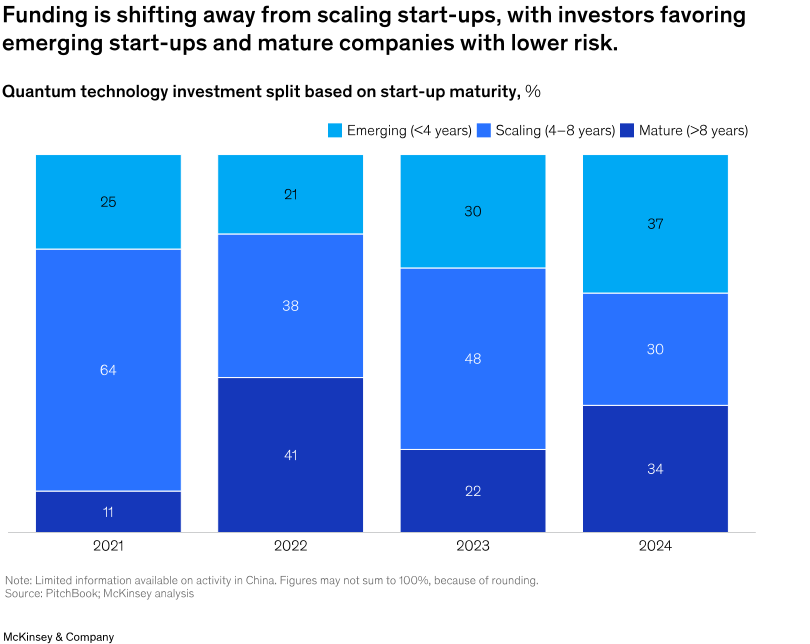
The fact that start-ups are no longer experiencing issues with garnering seed funding, as they did in the past, is indeed a positive. But too little focus on middle-stage start-ups could hamper growth in that part of the sector. In Europe, where the funding landscape’s volume and scale are smaller than that of the United States, middle-stage start-ups are experiencing a funding gap. Still, even these start-ups are beginning to raise Series B+ funding and are raising bigger ticket sizes, reflecting increased investor confidence in some cases.
Private funding stays strong, but public funding accelerates
Private sector funding made up two-thirds of QT start-up investments in 2024. But public funding is making significant strides when it comes to QT, rising 19 percentage points between 2023 and 2024 and making up 34 percent of total investment in start-ups.
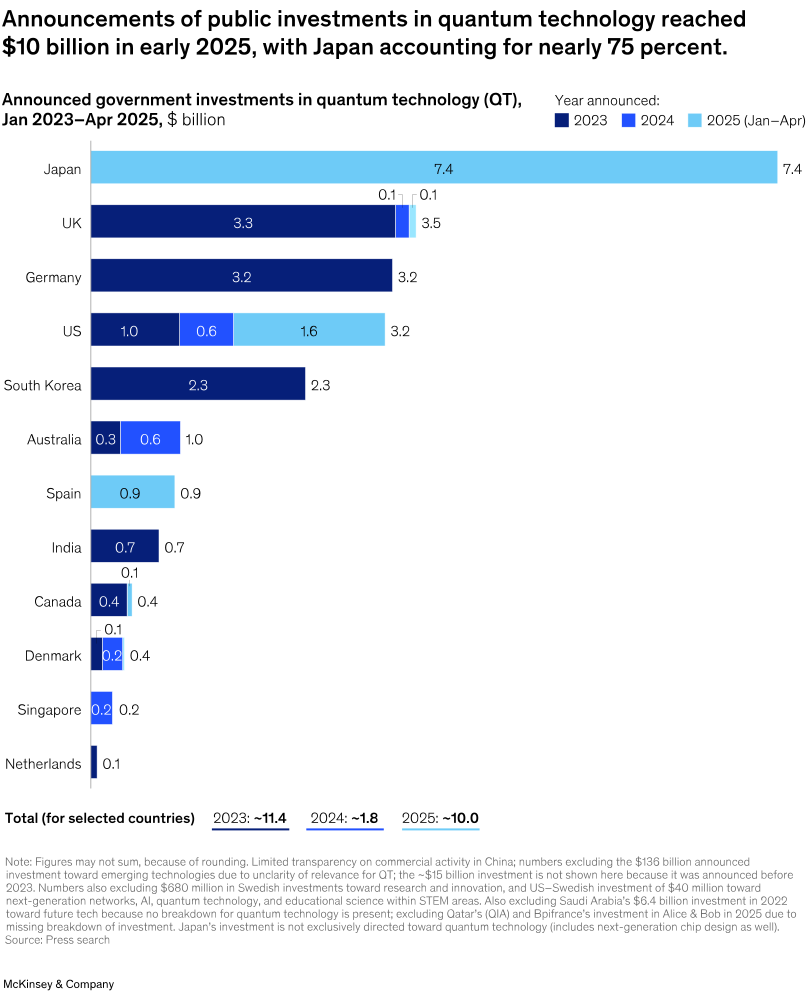
But start-ups are only part of the story. They garnered $680 million of government investments globally in 2024, but governments committed $1.8 billion in funding to QT more generally. That amount has already been surpassed in 2025. Public funding hit $10 billion by April, spiked by investment annoucements of $7.4 billion from Japan and $900 million from Spain (Exhibit 2). Other national announcements include Australia’s $620 million commitment to creating the world’s first utility-scale, fault-tolerant quantum computer, and Singapore’s $222 million pledge toward enabling its QT research and developing its talent over the next five years. Universities, investors, start-up accelerators, and research centers are also combining to form “innovation clusters.” These groups can be found in Boston, Chicago, Seoul, and Abu Dhabi, for example. The momentum reflects QT’s importance to economic competitiveness and concern about issues such as quantum computers becoming capable of breaking classical encryption. This latter phenomenon, known as “Q-Day,” could lead to an urgent need for quantum-safe security capabilities. The fact that public and private investors are working together is also promising—and necessary. Many government funders, as part of their goals, have plans to attract private funding for projects as well.
Which areas of QT lead in investments—and innovation?
QC receives the bulk of the funding, with 80 percent. Within QC, companies specializing in superconductors and those focused on photon networks receive the largest shares. QC market value could reach as high as $72 billion by 2035.
When it comes to innovation, QT advances today are driven by partnerships. Start-ups and the quantum teams of giants such as Amazon, Google, and Microsoft together have made step changes in performance and scalability.
As another trend, start-ups today focus on components and application software, but a value shift toward application software is expected within the next five to ten years. With full uptake of the technology, components will be more standardized and accessible, and customers will be native users of QT. As a result, there are interesting parts of the value chain beyond hardware where investors can focus. These are, at times, less risky.
Best practices for QT investors
The achievement of practical quantum advantage—that is, the point at which QT overtakes classical computing—and wide commercial adoption of the technology may arrive sooner than expected. Still, even with QT, due diligence, patience, and risk tolerance are required.
To make the best investment choices, it’s important to move beyond case studies of relevant players and even past behavior of the market. Here, we outline elements to consider before and after investing.
Before investing
Five factors could indicate promising quantum investments:
- Assess whether the company is setting itself up for success amid rapid technical advancements and the shifting nature of QT’s tech ecosystem. A good example concerns QC’s accessibility through the cloud. Start-ups working on this deployment method now will be well placed to thrive when the shift to cloud arrives.
- Confirm that if private customers are part of the business focus, first commitments to realize this commercialization plan have been made. This indicates that a company is solving a real-world problem and that future revenue pipelines are on track.
- Establish that if a company’s focus is research customers, the company has the ability—and a research institution or university customer base—to generate revenue via products rather than grants. This indicates a particularly effective route to income.
- Perform due diligence on the company in both business terms and technological terms, mitigating technical risk. Make certain that the right experts have completed this assessment so a company’s goals and its road to commercialization are understood deeply and holistically.
- Consider how many partnerships or potential collaborations are possible. The company should fit into the broader QT ecosystem because this can help determine future funding and provide clues to eventual consolidation. This is particularly relevant now because of the first major acquisitions taking place due to a shortage of talent, new breakthroughs in QT, and a desire to close off competitors’ access to promising start-ups.
After investing
Investors have unique capabilities to help their portfolio companies network, refine their business plans, and make nuanced business moves. Investors could consider the following strategies to help support and create value for companies in which they’ve invested:
- Continually reevaluate the company’s business model to catch problems quickly and identify opportunities early. Within each reevaluation, use case applications, early revenue from sales, and corporate customers should be prioritized.
- Help companies widen their network and build partnerships by introducing them to other companies within an investor’s portfolio universe and facilitating connections. Are there opportunities to help a company create synergy and build its expertise through new connections?
The future of QT investment
Industry use cases are not only voluminous but also wide-ranging—and QT also enables other technologies, such as AI and robotics, creating synergies that lead to additional market value. Robotics, for example, benefits from QT’s navigational capabilities and sensing precision. Dedicated quantum investors such as Quantonation and Quantum Coast Capital have been capitalizing on the market successfully for some time, and other venture capitalists are increasingly joining them. Those first industry acquisitions will not be the last, pointing to more potential early-exit opportunities. The fact that public and private investors are working together is also a positive development.
Risk is inherent in even the most promising markets, of course. But by adding quantum security to their portfolio, investors might be able to derisk other positions that might be affected should Q-Day hit early.
In short: When due diligence is applied, thoughtful investors have an exciting chance to get ahead of the next wave in QT breakthroughs.
Henning Soller is a partner in McKinsey’s Frankfurt office, Duc Nam Nguyen is a consultant in the Berlin office, and Martina Gschwendtner is a consultant in the Munich office.
The authors wish to thank Sara Shabani, Victor Kermans, and Waldemar Svejstrup for their contributions to this blog post.
1 Reinhardt Krause, “IonQ to buy Oxford Ionics in $1 billion deal as acquisition spree continues,” Investor’s Business Daily, June 9, 2025.
2 “Quantum error correction is crucial, but the ecosystem isn’t ready,” Riverlane, August 7, 2025; Quantum Research Blog, “How IBM will build the world's first large-scale, fault-tolerant quantum computer,” blog entry by Ryan Mandelbaum et al., IBM, June 10, 2025.