

Years of sustained asset growth have shielded the asset management industry from the need to fully embrace the digital age. But now, the tech-reticent industry faces mounting pressure to adapt. Investors have come to expect the ease of digitally enabled services that universal banks, wealth managers, and digital challengers provide. Clients are also shifting toward passive funds, which typically charge much lower fees, causing a decline in overall fee revenues and a spike in competition. In addition, many investors are demanding access to private markets, which have experienced meteoric growth in recent years.1 Furthermore, an evolving regulatory environment, dropping interest rates, and an unreliable stock market mean the days of easy gains and traditional business models have become a thing of the past (Exhibit 1).
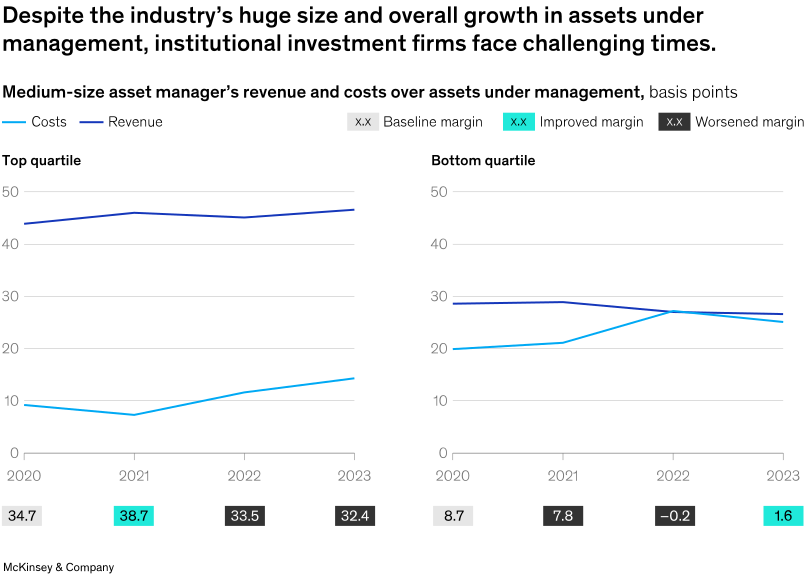
While some top asset managers have successfully leveraged technology, the industry as a whole has struggled to harness technology’s power. To stay competitive and position themselves for future growth, asset managers need to focus on end-to-end digital transformation while aligning new technologies with the relevant aspects of the business. In this post, we outline the benefits of a modern tech estate to enable digital transformation, obstacles to overcome, common mistakes to avoid, and a business strategy to accelerate the transformation.
The benefits of tech modernization in asset management
The conservative nature of the asset management industry and its strict regulatory environment make it challenging to adopt digital solutions. But digital transformation leads to improved efficiency, more-secure and profitable investments, and better adherence to compliance and regulatory requirements. Ultimately, it improves risk management and investment performance to the benefit of all market participants.
A modern technology and data estate has a variety of tangible business benefits.
Enhanced decision-making and investment strategies. Top asset managers are now deploying data platforms with a single authoritative source for organizational data (a “golden source”), such as an investment book of record and accounting book of record for risk management. These platforms increase accuracy and reduce reconciliation efforts while producing faster, more-secure investment decisions. Especially for asset owners, the ability to rapidly gain a holistic portfolio perspective is crucial.
Ability to leverage best-in-class solutions from broader ecosystems. Digital technology enables asset managers to interact in broader ecosystems, where they can profit from best-in-class solutions, such as looking into the risks and performance of private-credit assets. The technology also allows clients to interact with asset management offerings by providing, for example, instant access via APIs rather than sharing quarterly reports.
Enhanced risk management and compliance. Building on a central data platform, modern solutions support the monitoring of large rules-based portfolio strategies almost in real time. Vast automation capabilities with high straight-through-processing (STP) rates also provide benefits, such as automated reconciliations. In addition, capabilities that come directly from data platforms—such as lineage and traceability of net asset value and real-time streaming of performance and accounting data—become more critical as portfolio strategies become more complex.
Benefits from AI and gen AI. Modern technology is a prerequisite to benefit from the latest developments in AI and gen AI. Copilots or traditional AI–powered tools that assist asset managers across front, middle, and back offices are already becoming essential for user-friendly querying, recommendations for relationship managers, the automation of processes dealing with unstructured data, and the ability to query large data sets to make predictions.
Scalability and responsive, resilient systems. Modern technology also provides its own inherent benefits—for example, access to stronger cybersecurity, a resilient cloud-based infrastructure, and engineering tools such as continuous integration. These benefits have become a prerequisite for both attracting tech talent and achieving much higher returns on tech investments.
Obstacles to enabling a digital backbone
Asset managers face several challenges in the journey toward digital technology transformation.
Lack of alignment between business needs and traditional optimization needs. For many asset managers, transformational aspirations—such as launching new products, creating better digital experiences for customers, and managing risk for newly evolving asset classes—collide with the need to solve long-standing pain points, such as automated data reconciliation and increasing STP rates.
Legacy systems and high technical debt. Many industry platforms are not ready to deliver new business functionality immediately, because they rely on legacy code and infrastructure, have tightly coupled platforms, and lack data governance processes and clear data pathways.
Difficulty attracting tech talent. Historically, resources for change are limited, and there is a heavy internal focus on running the day-to-day operations and activities of the institution. These factors make it difficult to attract or afford new talent.
Common mistakes and setbacks
In our experience, asset managers make three major mistakes when attempting to deliver a digital transformation.
Implementation of tech or migration of IT to a large platform without transforming the business and processes. Whether building a platform developed in-house or relying on third-party solutions without bespoke modifications, asset managers need to start by critically reviewing business processes. This review must explicitly include the front office and needs to be jointly designed with portfolio managers and the risk team.
Lack of a long-term blueprint for the technology and operating model. Sustaining a multiyear transformation requires clear commitment from top management and sponsorship throughout the lifetime of the program. In planning for digital transformations, C-suite leaders also need to plan for a series of stable plateaus—phases in which new digital capabilities are functioning smoothly before moving on to the next phase—while moving toward their ideal target state. Each new phase should deliver business value while allowing the business to accommodate any unforeseen changes, such as an M&A event.
Missing internal capabilities and mismanagement of vendors. Given that the capacity for internal change is typically limited, digital transformations rely on third parties to provide an out-of-the-box platform or to help build a customized one. Either way, both the IT and business domains will need to steer the third party. With in-house builds, asset managers need to take a nuanced value-assurance approach, consistently evaluating and challenging technical decisions and quantifying the value of each choice, to prevent the vendor from defining the scope and estimates most beneficial for them. Similarly, asset managers overseeing the implementation of large out-of-the-box front-to-back (F2B) platforms need to fully grasp the changes required for the operating model before adopting an F2B platform.
Insufficient focus on data capabilities and data integration. Data is the central starting point for any platform. While F2B workflow and design elements as well as excelling on specific functional capabilities can provide value, they always rely on the golden source of data for holdings information, risk analytics, investment decisions, and other processes. Siloed or low-quality data assets often lead to unsuccessful transformations.
Five levers for digitally enabled asset management
A clear business strategy is essential for a successful technology transformation. Five business enablers are proven to significantly accelerate the transformation journey (Exhibit 2).
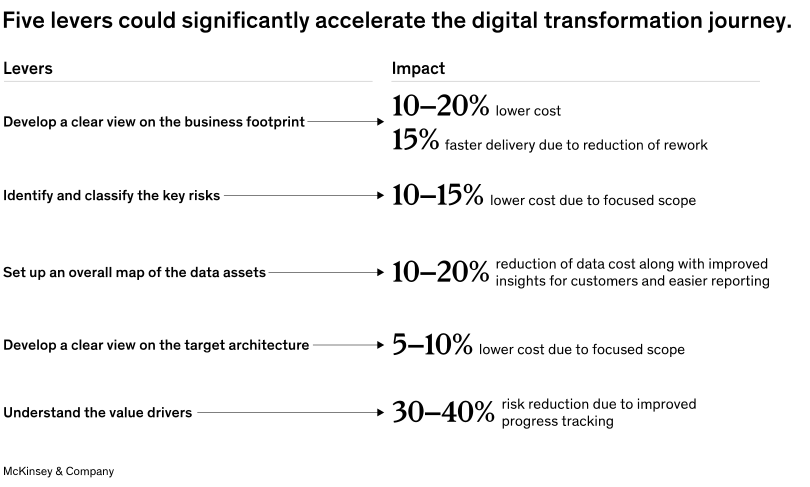
Develop a clear view on the five-year business footprint, including client segments, products and asset classes, and target markets, to develop a well-defined ambition for the underlying technology.
Identify and classify the key risks of the current vendor landscape and required or possible mitigation measures, such as support for legacy solutions if a vendor goes out of business.
Set up an overall map of the underlying data assets, including not only the storing and processing of data but also the opportunities from incorporating data insights into relevant workflows.
Develop a clear view on the target architecture, including when to use software as a service and when to differentiate through proprietary solutions.
Understand the value drivers of the transformation and develop a business case for the overall transformation linked to the road map.
Using these levers could successfully reduce the risk of the overall program.
More than ever, asset managers and owners need to embrace technology not only as a differentiator but also as a prerequisite for profitable, sustainable operations. Modernizing platforms, either with self-builds or by using large third-party platforms, is not easy. But asset managers that learn from previous attempts can successfully deploy state-of-the-art platforms to achieve significant revenue and cost improvements while reducing risk.
Henning Soller is a partner in McKinsey’s Frankfurt office; Stefan Schorsch is a partner in the Zurich office, of which Alexey Ivanov is an alumnus; and Sebastian Schöbl is an associate partner in the Berlin office.
1 Pavel Ermoline and Blazej Kupec, “Investors are increasingly attracted to private markets. Why?,” World Economic Forum, December 21, 2023.