

AI has already changed R&D and will change it radically in the coming years. For companies that can harness new technologies in the best way, this means faster development cycles and the ability to be more innovative, launch more products, and increase market share.
McKinsey estimates that using agentic AI to accelerate R&D could increase economic value by $360 billion to $560 billion annually across the industries studied, equivalent to a double-digit percentage uplift in EBIT. For complex manufactured products, AI could accelerate development by 20 to 80 percent and deliver productivity worth 10 to 15 percent of overall R&D. However, most of these benefits remain in the future for now.
The barriers and brakes slowing AI adoption in R&D were a focus at McKinsey’s third annual R&D Leaders Forum, where chief technology, R&D, engineering, and innovation officers gathered for a day of demos, keynotes, and peer exchange.
While forum attendees agree that agentic AI will reshape product development, they are less certain about where to start, what to build, how to scale, and how to lead the broader organization into the AI era. Attendees say the constraints on scaling AI models commonly involve the operating model and data foundations.
When AI efforts are siloed, organizations duplicate infrastructure, software, and talent, slowing overall progress.
Confidence, step changes, and the execution gap
R&D leaders are confident about their companies’ AI maturity and impact. In a survey we conducted before the R&D Leaders Forum, 58 percent say they are out in front of other functions.1 Furthermore, 77 percent report clear change in some areas thanks to successful AI adoption, though less than a third report major or fundamental change (exhibit).
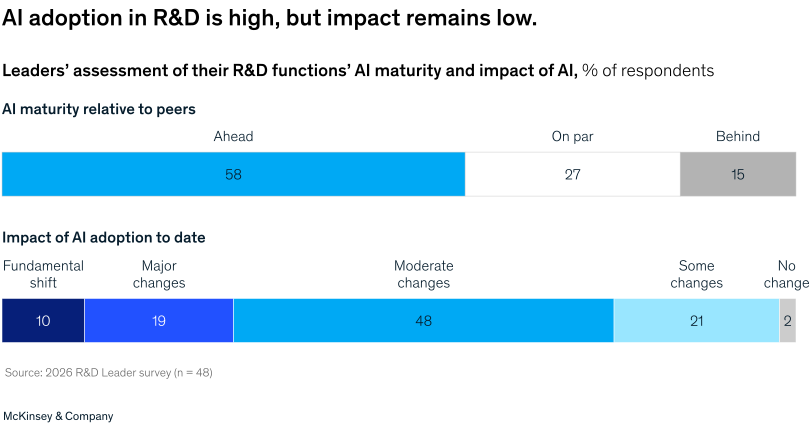
R&D leaders are also setting ambitious targets. Most are aiming at step change improvements across metrics including speed to market, growth and innovation, spend efficiency, product cost, and prototype reduction. Still, the execution gap—the distance between ambition and realized, scaled impact—remains.
Five ways to improve R&D execution
At the forum, in discussions of how to scale AI-enabled R&D, the following five themes surfaced consistently.
Ask and answer the right question
To create a clearer picture, ask, “If we started from scratch today, how would we redesign product development end to end?” By answering this question, leaders give themselves a direction and a destination against which they can sequence and judge investments, especially if they can attach a quantified value to the changes. Leaders who don’t address the question lack a vision or North Star, and as a result, they accumulate disconnected one-off builds without large-scale impact.
Scale beyond the board mandate
In many organizations, the board is already pushing for AI-enabled transformation. The much harder problem is convincing, equipping, and mobilizing the rest of the enterprise into scaled impact.
We surveyed our forum attendees, asking about seven core R&D use cases, including AI insights for product strategy, digital twins, root-cause analysis agents, the digital thread, and virtual validation. Nearly half of the use cases attendees reported are piloted or scaled up to a point, but only 13 percent are scaled beyond proof of concept. This is the pattern we see across the economy, where most function-specific generative AI use cases never leave the pilot phase.
Leaders who manage to break out of pilot cycles treat scaling as a discipline in its own right. For example, they embed a platform team (paired with engineers) in the workflow, standardize integration into existing product life cycle management and engineering tools, or fund for adoption alongside development rather than assuming a successful pilot will scale itself.
Experiments alone don’t create value. Value comes from repeatable, professionally managed foundations that deliver applications with quality and speed.
Redesign the operating model, not just the tool kit
Tools are arriving faster than R&D functions can absorb them. And even when the right tools are identified, the binding constraint is commonly the operating model, including established workflows and roles, governance, and decision rights. Bolting a copilot onto a legacy process yields a faster legacy process, not a redesigned one.
We see failures and successes, and the biggest difference is often the people. Change management is number one. It’s less about technology and more about having the right people to drive it.
For example, our R&D forum attendees identified shifting verification and validation from physical prototyping to in silico testing as an effective lever to counter resistance in some instances. For safety-critical, regulated products (for example, aerospace, automotive, and medtech products), where such a shift would be heavily regulated, the practical play is to expand in silico testing where standards already allow while building the validation case elsewhere.
The frequency with which our forum leaders define issues as barriers to scaling AI in R&D shows how existing systems are points of friction. The top issue is data availability and quality, selected by 56 percent, followed by integration of AI into engineering workflows and tools (50 percent). Smaller shares expressed concern about securing funding and proving ROI, getting teams to adopt new ways of working, identification of the right use cases, delivery capacity and skills, and issues related to legal, intellectual property, and governance.
Treat data as a strategic capability
In nearly every use case discussion, participants brought up data availability and quality as a barrier to progress. To address this, R&D leaders who attended the forum are investing ahead of demand in semantic models, source-of-truth data, reusable platforms, and engineering data foundations that AI systems can use reliably.
The most proactive organizations are now treating data infrastructure as a strategic capability, so that each new application compounds on a common foundation instead of starting from scratch. In our work with R&D organizations, we have found that pairing agentic AI workflows with enterprise data foundations is what separates scaled impact from one-off pilots.
Redefine what engineers and scientists do
The near-future engineer’s world will comprise less manual execution, more orchestration, more critical judgment, and more domain expertise at critical moments. There also will be more directing, curating, and validating of AI outputs—capturing knowledge for reuse and deciding where humans must stay in the loop. As agents take on more of the execution, the engineer’s value shifts from doing the task to directing and verifying the system and its outputs.
The next move is organizational
Access to AI is now an everyday business asset, but the ability to scale it remains rare. R&D winners don’t simply automate work; they learn faster, validate faster, and build organizations that keep adapting as AI evolves. The first move is to set a North Star—a quantified vision of AI-native product development tied to the value at stake and owned by the R&D leadership team.
That vision helps turn a scattered set of promising tools into a sequenced road map. It clarifies which workflows to redesign first, and in what order. It highlights the data, technology, talent, and operating-model foundations to build beneath them. Companies that set clear R&D vision and targets and redesign their workflows to meet them will gain an advantage that less agile organizations will struggle to match.
For leaders ready to close the execution gap, McKinsey’s Product Development Practice works alongside R&D teams to set the vision, redesign workflows, and build the data and talent foundations described above. Learn more.
The authors wish to thank Huston Julian, Maria Laura Arguedas, Najaf Mooraj, Rizwan Huq, and Ruijun Zheng for their contributions to this blog post.
1 2026 R&D Leaders Survey (combined cut n = 48).