


Data center demand, driven by the needs of high-performance computing, data management, cloud computing, and generative AI technologies, among many others, shows no signs of abating. But established air-cooling systems are struggling. We project the global data center cooling market to reach $40 billion to $45 billion by 2030, with liquid cooling accounting for $15 billion to $20 billion of that.
This rising demand is straining local grids and water resources. In the United States, data centers currently account for less than 0.1 percent of total water use, but consumption is expected to triple by 2030. This growth, however, is not equally distributed, with approximately 40 percent of current US data centers located in high water-stressed areas. In hot spots such as Ashburn, Virginia, data centers are driving water demand and could account for up to 90 percent of local industrial water use by 2030. Communities in major data center hubs are beginning to feel the impact and are pushing back. Over the past two years, approximately $64 billion of US data center projects have been delayed or canceled, largely due to community resistance, environmental concerns, and zoning or permitting challenges. Technologies such as liquid cooling can reduce direct water use and are a critical element in lessening the water burden. Liquid cooling and data center water abatement alone, however, cannot resolve local water scarcity issues. Collaborative action among co-located stakeholders at a water basin level will be equally as important.
It’s getting hot: The benefits of liquid cooling
Liquid cooling is more efficient and environmentally friendly than established air-cooling methods for several reasons. First, water’s higher thermal conductivity and specific heat capacity allow it to absorb and transfer heat more efficiently, maintaining lower operating temperatures for critical components. Liquid-cooling systems can reduce energy consumption by more than 27 percent compared to air-cooling systems.
Liquid-cooling components can be smaller than their air-cooled counterparts for the same performance rating. This enables the development of data centers with ever greater power density. A more compact footprint also requires less redundant auxiliary equipment, such as power supplies or in-rack backup power, reducing the necessary capital expenditure for a new server rack optimized for water cooling.
Liquid cooling is also quieter. Traditional air-cooling systems rely on fans, which can generate noise, especially in high-performance computing environments. In contrast, liquid-cooling systems operate quietly, relying on far fewer, lower-performing fans per server, making for a quiet work environment and a lower risk of noise pollution.
Liquid-cooling systems also support the reliability and longevity of the wider system. They are less susceptible to external contaminants such as dust and dirt that can affect air-cooled systems. By maintaining optimal operating temperatures, liquid-cooling systems can extend the lifespan of server components, reducing the frequency of hardware failures and the need for replacements.
Routes to liquid cooling
Currently there are three prominent liquid-cooling methods for data centers.
- rear door heat exchangers (RDHx): A specialized door to the rear of the server rack chills hot air expelled by the servers while coolant transports the absorbed heat to a secondary cooling system.
- direct-to-chip (D2C) systems: The system circulates a cold liquid over integrated circuits, with the absorbed heat carried to a secondary cooling system.
- immersion cooling: The server is submerged in a liquid that absorbs heat directly from components, with the heat transferred to a secondary cooling loop.
Cost and sustainability advantages
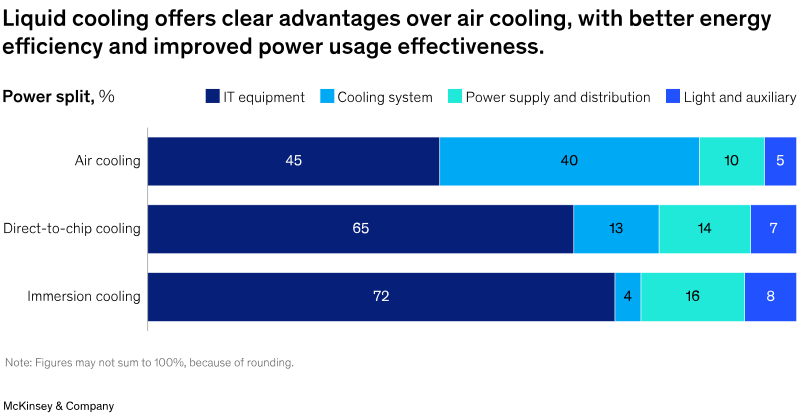
In addition to operational benefits, liquid cooling has cost and sustainability benefits. Power usage effectiveness (PUE), for example, is an effective way to measure the energy efficiency of data centers by comparing the total facility energy consumption to the energy explicitly used for computing equipment. Liquid cooling leads to a clear advantage where a far larger proportion of energy consumed by the data center is used by value-adding IT equipment as opposed to cooling and other support systems (exhibit).
Capital expenditure for liquid-cooling systems in data centers is higher than that for traditional air-cooling systems, but our estimates show the break-even points have shorter timelines, ranging from within the same year to three years, depending on the cost of electricity for the data center.
Furthermore, operating expenditures benefit from liquid-cooling systems due to their greater energy efficiency and better PUE. With a greater share of the energy being used by the IT equipment, running the same tasks on the same equipment can be achieved while receiving a 31 percent or 37 percent lower energy bill for D2C or immersion cooling, respectively, compared to air cooling. Liquid systems are therefore of particular interest to operations in countries with high energy costs.
Challenges and potential drawbacks
As mentioned, liquid-cooling systems have a higher upfront cost for components and installation complexity. For instance, they require a network of pumps, tubing, and heat exchangers, all of which need to be designed and installed. The risk of leaks is a significant concern, as even a small leak can cause substantial damage to sensitive electronic components. Replacing or upgrading components can also be more complicated due to the integration of the cooling system into the server infrastructure.
Another potential issue is the lack of component standardization. Unlike air-cooling systems, which benefit from high uniformity and compatibility, liquid-cooling systems have fragmented component approaches, designs, and standards, which increases design and maintenance complexity. Liquid cooling also requires a certain level of infrastructure and specialized setups to work successfully and safely, including reinforced floors and foundations, as well as advanced fluid management protocols. Retrofitting existing air-cooled centers is also potentially costly.
Cool heads
Despite the hurdles, liquid-cooled data centers offer a promising future that better meets performance demands, cost pressures, thermal management targets, and sustainability goals. That combination makes it a compelling topic on boardroom and C-suite agendas. The long-term benefits of lower energy cost, higher efficiency, smaller physical footprint, and greater system reliability seem set to draw more organizations to a liquid-cooled future.
The authors wish to thank Shraddha Kumar for her contributions to this blog post.