

The current conflict in the Middle East is not just another source of supply chain disruption for global businesses; it is a test of whether operations can move from reactive firefighting to proactive transformation. Now is the moment to ask a simple question: Can your transformation keep pace with disruption?
Discussing operations, Ricardo Moya-Quiroga Gomez, McKinsey partner and European leader of the McKinsey COO Excellence Program, says:
“These very same resources and capabilities, starting with strong COO leadership, remain crucial as companies work to adapt and pivot their global supply chain flows in response to the ongoing conflict in the Middle East.”
Three business myths worth dispelling
Operations leaders are crucial to the future prosperity of their organizations. At times of systemic stress, making the right decisions is more important than ever, and that means looking closely at data that can help you make the best choices. Let’s address three contextual myths that operations teams are grappling with today.
- Supply chain transparency has improved since the pandemic.
Not so. McKinsey data shows that the share of companies reporting awareness of risk at Tier 2 suppliers (and beyond) peaked in 2022 post-COVID-19, then fell in 2023 and 2024. Even with the threat of tariffs, companies’ risk management capabilities have yet to return to 2022 levels. - Digitization is accelerating.
Not exactly. At precisely the moment when resilience depends on digital capabilities, many organizations are pulling back. Cost pressures, competition from major tech projects (such as enterprise resource planning replacement), and concern over finding the right tools mean that efforts to build long-term capabilities are being sidelined. - Geopolitical disruption is driving global retreat.
Not entirely. Shifts in the supply chain footprint often make sense for other reasons, too. The attractiveness of many locations that have served as offshore manufacturing hubs for decades has declined in basic economic terms due to changing labor costs, talent availability, and energy and infrastructure costs. Meanwhile, transformational technologies such as generative AI, digital twins, and robotics change the game when it comes to how, where, and when things can be profitably made.
Together, these myths obscure a critical reality: Many operations functions are less prepared today than they were in 2022—despite a more volatile environment.
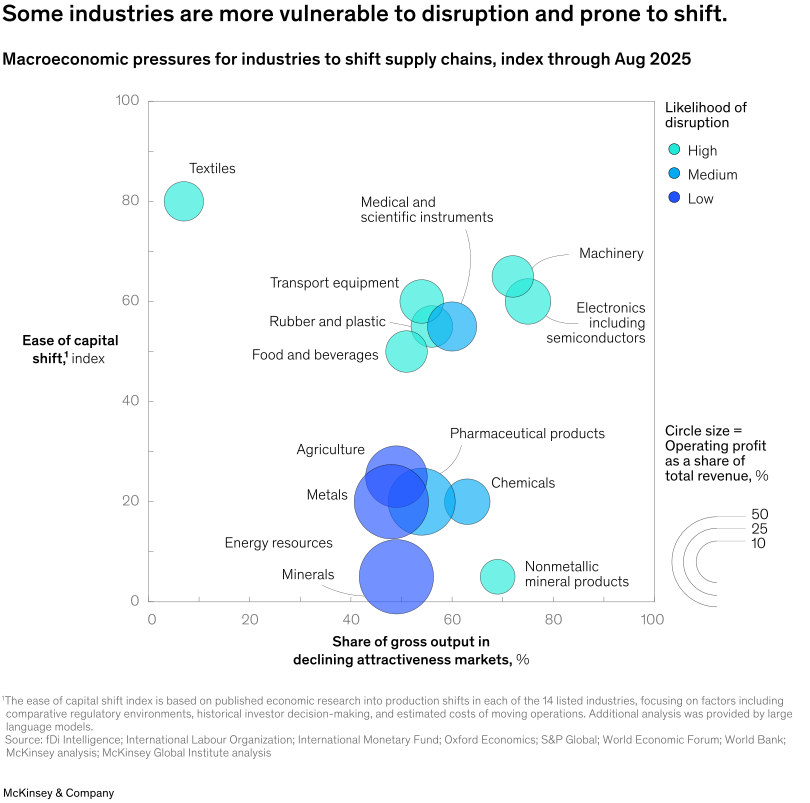
Industries particularly prone to global shifts are vulnerable to underperformance if their operations and supply chain management practices fall short (exhibit). Forward-looking operations leaders seek to understand the dynamics and outlook for their industry when making their case for investment. Conversely, those who manage to sustain or quickly restart investments, particularly in new technologies and their adoption, are most likely to come out as resilience winners over the longer term.
An operations continuum to increase resilience
Operations leaders and the C-suite must treat operational transformation as a continual process, yet the level and pace of change have fallen, with leadership teams moving on to other projects. Leaders need to understand (and impress upon others) that the operations function is the primary driver of the sustained business transformation needed today.
The old story of disrupting yourself before others disrupt you has a new urgency largely due to the accelerated pace of technological advancement, and the impacts flowing from geopolitical disruption. Now is a key moment to refocus on three areas.
1. From awareness to foresight
Awareness is essential to operational excellence, with foresight as the ultimate goal. Our survey data on supply chain risk shows how more than 90 percent of respondents have visibility into Tier 1 supplier risks. That falls to less than half for Tier 2 suppliers, though this measure has improved in recent years. Only a small minority have insights into Tier 3 suppliers.
The weakest scores are given to “supply visibility over the next five years.” This lack of transparency leads to greater inventory buffers and other basic risk mitigation tactics, which in turn lead to higher costs and reduced cash flows. A deep, end-to-end understanding of the supplier ecosystem along the chain, on the other hand, gives an organization the muscle to flex into foresight.
Example: A global advanced-industries manufacturer with operations on several continents sought to understand where its value chain was most exposed and how it could reallocate production. The company integrated macroeconomic signals, trade flows, and sector-specific cost drivers to simulate a range of future scenarios. The analysis revealed that 10 to 20 percent of cost of goods sold was at risk across scenarios, but that five to 15 percentage points of that exposure could be addressed by reorganizing the production footprint throughout the network. Leaders were trained to refresh the analysis annually. The business built a model to detect emerging risks and suggest potential counteractions to manage risk exposure and take preventive action.
2. From fixed to flex capacity
Manufacturers need the ability to dynamically adjust production, accelerating or slowing volumes in real time to maximize the value of their global asset base. This builds on the operations leader’s traditional mandate of optimizing performance and raises the bar significantly. Operations must now be able to rapidly scale productivity when demand rises and reallocate capacity across the network when conditions shift. Achieving this requires end-to-end transparency across sites, suppliers, and constraints, as well as a clear view of substitution options and trade-offs. Without this level of visibility, organizations remain reactive. With it, they can actively shape outcomes.
Example: A global industrial equipment manufacturer facing volatile regional demand implemented a networkwide control tower integrating plant capacity, labor availability, and supplier constraints. This enabled real-time reallocation of production across three regions and dynamic product substitution where components were constrained. As a result, the company improved service levels by 10 to 15 percent while reducing idle capacity by more than 20 percent, without additional capital investment.
3. From low-cost to low-exposure sourcing
Leading players are changing the way they evaluate sourcing alternatives. A pure cost-per-unit rationale for sourcing decisions is being complemented by resilience criteria. This accelerates the usage of multisourcing across geographical boundaries, long-term contracts, and advanced digital planning to strengthen resilience and minimize excess inventory.
Example: A global consumer goods company redesigned its sourcing model to include multisourcing across three continents. The company had already adopted multisourcing across suppliers, but without geographic exposure as part of the supplier selection criteria. By improving this aspect, the company achieved 30 percent fewer stockouts and 20 percent lower emergency logistics costs, while maintaining target service levels and freeing working capital for growth.
A leadership moment
Now is the moment for leaders in operations to take the reins and steer their organizations through turbulence. Operations has become the decisive battleground for resilience. In a world defined by persistent disruption—from geopolitical tensions to rapid technological change—the ability to adapt, reconfigure, and scale operations is what separates leaders from laggards.
This is a defining moment. The role is expanding from optimizing performance to orchestrating transformation across the enterprise. That means moving beyond incremental improvements toward fundamentally rethinking how supply chains are designed, how decisions are made, and how risks are anticipated.
Organizations that continue to treat operations as a support function will struggle to keep pace. Those that elevate it to a strategic driver—investing in foresight, digital capabilities, and flexible networks—will be better equipped to absorb shocks and capture new opportunities.
We are working with operations leaders to turn these ambitions into action, helping them identify vulnerabilities, unlock value, and build the capabilities required for sustained performance in an uncertain world. If you would like to explore how your organization can do the same, we would welcome the conversation.