




Few top-tier legal markets are as primed for AI-driven disruption as Australia's. Concentrated relationships, institutional buyers with long horizons, a public sector client base that rewards process efficiency, and sophisticated in-house teams create clear pressure on firms to demonstrate value in how legal services are delivered.
AI is driving a fundamental shift in law firm business models, corporate legal functions, and how legal services are delivered. While many firms remain in an experimentation phase—focused on tool trials, policy setting, and data preparation—there are increasing signs of structural change. Clients are beginning to expect greater transparency, faster delivery, and clearer evidence of value from AI-enabled efficiency gains. At the same time, advances in AI reasoning are expanding the range of tasks technology can support. Together, these forces are increasing pressure on legal institutions to decide where to move early, where to build distinctive capabilities, and how to sustain relevance.
Our analysis suggests that, in a conservative scenario, 15 to 25 percent of total net legal hours could be affected by AI-enabled automation or augmentation disruption over the next five to seven years (Exhibit 1).
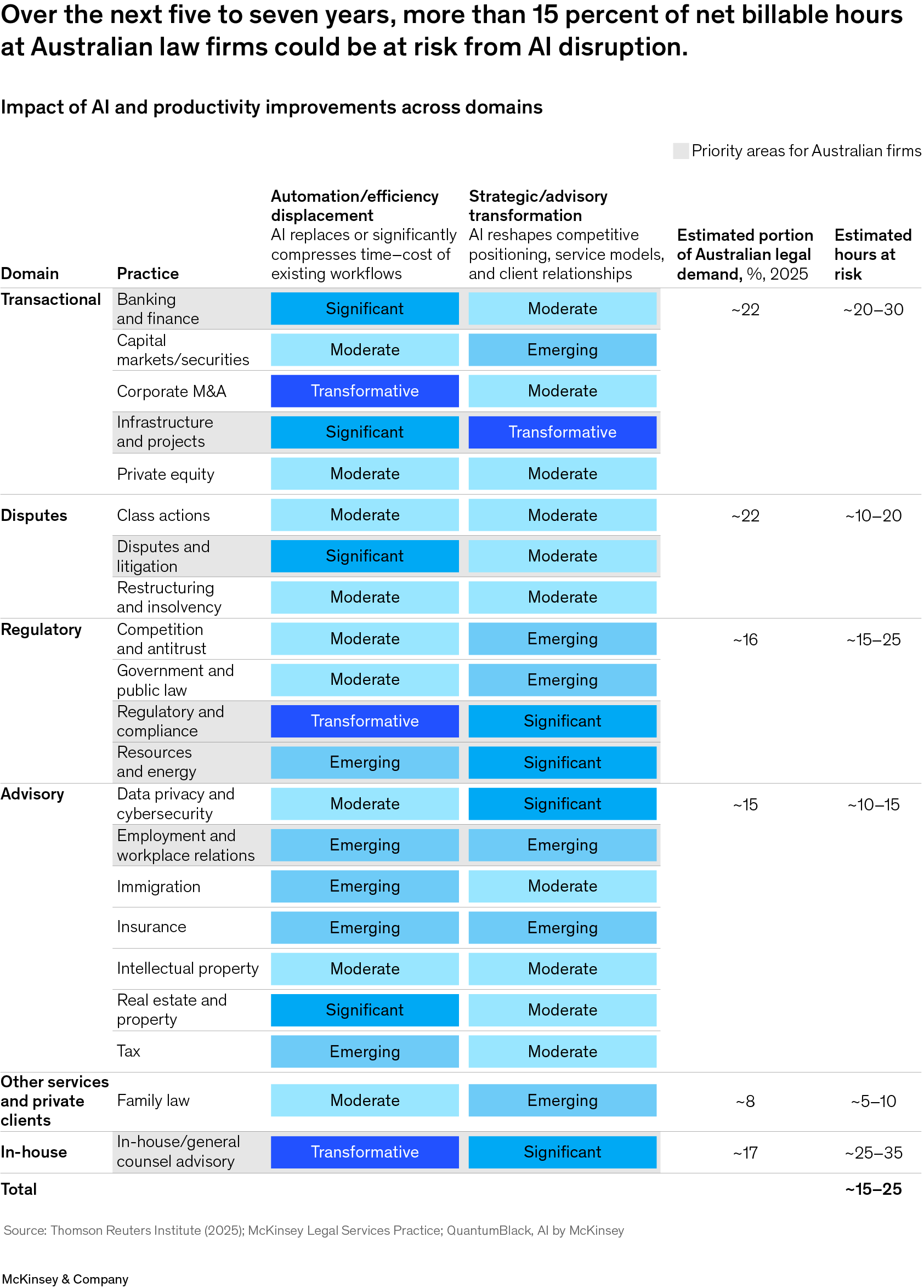
AI could change where profits are generated and which firms can reinvest fast enough to stay preeminent. Firms that understand these shifts and respond to them can help shape the legal market over the decade ahead.
Insight #1 – Preeminence requires platform infrastructure, not just partner brilliance
To keep pace with the market and client expectations, firms could consider transitioning their institutional knowledge—traditionally embedded in core document management systems and individual practitioners—into structured, reusable assets that support AI-enabled delivery. Over time, this may affect how firms meet client expectations on value, as well as their ability to attract and retain talent.
As baseline AI tools become omnipresent, access alone will no longer differentiate. Advantage is likely to depend, in part, on how effectively firms integrate these tools into distinctive, end-to-end ways of working.
Insight #2 – Profit pool growth replaces revenue growth as the core performance metric
Firms’ financial focus may increasingly shift from top‑line revenue to disciplined profit pool growth. This may involve a shift in emphasis from gross fees towards metrics such as profit per partner hour, matter-level contribution, and client profitability by practice or sector.
Partner productivity may be a further economic lever for firms to unlock material uplift without waiting for demand growth. Partner time may become even more valuable as firms consider how to direct effort towards higher-complexity work, client counsel, supervision, and quality assurance.
Insight #3 – Pricing architecture needs to move at the speed of AI
AI has the potential to disaggregate legal work according to the judgement, expertise, and relationship capital required. Routine work such as drafting, review, and research may move towards commodity pricing. Strategic advice, regulatory relationship capital, courtroom advocacy, and complex transaction structuring may retain or increase their premium.
The firms that capture AI’s economic upside are likely to be those that proactively design tiered service architectures to distinguish AI-delivered work, AI-augmented work, and pure advisory—and price each deliberately. Absent this architecture, pricing could become a series of ad hoc, client-by-client negotiations that diminish the strategic value of the AI investment.
Insight #4 – Proprietary data is now an important source of differentiation
The commoditisation of general-purpose legal AI tools appears to be accelerating faster than many Australian firms have internalised. Competitive advantage may increasingly depend on how firms develop and use proprietary data: a firm’s own matter history, precedent library, regulatory submission archive, and client knowledge base, structured and activated for AI training.
In Australia, firms often hold valuable practice-specific data sets in domains such as resources and energy, financial services regulation, and industrial relations. The extent and duration of any differentiation will likely depend on how quickly firms act and how effectively they operationalise their data assets.
Insight #5 – The talent pyramid will be reshaped and reskilled
The associate-to-partner pipeline has long been defined by a guild approach, where junior lawyers are credentialed and then build judgement through high volumes of supervised work. AI may reduce the volume of some of this highly repetitive work.
One emerging profile combines deep domain expertise with the AI fluency and commercial acumen needed to deliver high-value AI-assisted work. While some firms are beginning to integrate technology capability into delivery structurally, broader questions remain—such as how to develop judgement without deep early-career repetition, what the optimal shape of the pyramid could be across practices.
An agenda for managing partners
The decisions shaping how firms respond to AI are rapidly moving from exploration to execution. Managing partners who treat the next 12 months as an opportunity for deliberate repositioning could be the architects of how the Australian legal market evolves. They may consider the following priorities:
- Choose and fund two to four franchise arenas. Concentrate investment in sector and practice areas where you can credibly lead, deepening capability, redesigning workflows, and driving innovation in those domains.
- Redesign the business model. Define premium advisory, AI-augmented, productized, and partnered work, and integrate these into firm strategy beyond the IT function.
- Rebase on profit pool discipline. Strengthen visibility into matter economics and pricing to pinpoint where AI-enabled efficiency creates value.
- Install tiered commercial architecture. Pilot fixed pricing on repeatable work, build pricing analytics, and differentiate AI-delivered, AI-augmented, and partner-led work. Train partners to articulate value beyond hours such as outcomes, risk reduction, and speed.
- Develop a data moat. Treat knowledge infrastructure as strategic capital, enabling more consistent and responsible use in AI-enabled workflows.
- Redesign the talent engine around judgement. Transform the talent system and build capabilities in effective AI use, risk spotting, client advisory, and quality assurance as roles evolve.
- Embed a “fastest learner” culture. Invest in continuous upskilling and rapid capability building to help teams adapt as AI reshapes ways of working.
- Build and publish AI governance standards. Establish clear standards on approved tools, human oversight, data handling, and accountability, and position governance as a client-facing strength.
AI could usher in profound shifts in the way legal services are delivered, and in the business models of law firms and their clients. Managing partners who act now can reposition their firms for the future.