
In the world of competitive cycling, pedal pushers know that the Grand Tour—comprised of the Giro d'Italia, the Vuelta a España, and the Tour de France—are the most iconic races. The contests historically evoked excellence, endurance, and glamour. That is, until 2012, when revelations of systemic doping, most notably by American star and cycling darling Lance Armstrong, put the brakes on public enthusiasm. It also dampened sponsors' zeal. The scandal saw not only Armstrong and his team, but the entire sport fall from grace.
The title sponsor of the 1984-founded Dutch cycling team pulled their support, declaring their faith in the entire industry shattered. "[We are] no longer convinced the international professional world of cycling can make this a clean and fair sport," they announced.
The Dutch team refused to give up. They were determined to get back on the bike and write a new, clean chapter for the future of cycling. They hired fresh leadership, staffed new engineers and mechanics. They rebuilt the entire team from scratch, opting for unknown talent over famous names. Short a sponsor (from which they traditionally took their team name), they adopted a new title: Blanco—the blank page.
In 2024, an Associate, Jens Hegeman, read a book about their efforts. "Could we help this team?" he wondered. Turns out that the answer was 'yes.'
We sat down with Partner Sven Houthuys, Principal Data Scientist Marnix Koops, and Data Engineer Thomas d'Hooghe to hear how we helped the team (now renamed Visma–Lease a Bike after a new sponsor) go from uphill climb to coasting.
This study starts with a book.
Sven: Yes, they had written the story of this period of losing everything and starting from scratch. And how they had struggled. It's an incredible story about leadership and perseverance to build a high-performing team. And then the book said, "We want to take it to the next level. We have to be one step ahead." These teams are so competitive, and they are always looking for a new edge. And the Associate said, "I think we can help them." So, we wrote to the author of the book and he got us in touch with the team's head of performance.
How did you convince them that our Firm has a part to play in keeping a step ahead in cycling?
Sven: We showed them the sailing race use case, and we brought in our head of QB in the Netherlands, Joris van Niel. We said, "We really think there's something we can optimize here with data." TVL is a very innovative team, so they were open minded. They said, "What can we make before the Tour de France?" That was in three weeks.
That seems like the highest stakes possible in an incredibly short amount of time.
Marnix: It is. In TVL's home, the Netherlands, this is one of the biggest sports. It's a matter of national pride. Many people do it as a hobby and follow the races. The World Tour is the champion's league with the best cyclists from all over the world. And the Tour de France is the most difficult and most prestigious of all the races on the Tour. It's the top event with the most hype and most media coverage. So yes, this was very high stakes.
Were you personally excited about the project?
Marnix: Yes. I'm a big cycling fan. We all are. And TVL is the best cycling team in the world. I'm Dutch, so there's a bit of national pride, but they are. And here we all were, talking with them about data modeling. I'm a data scientist and I never expected that these two passions would be connected. It really was a once-in-a-lifetime feeling.
So you start the study—bringing a whole new meaning to the word 'sprint'—what can you achieve on this three-week timeline?
Sven: The Tour de France is a 21-day race. It happens in what they call 'stages.' And for each stage, they have a strategy for the whole team or peloton: when you attack, when you follow. Plus, they are managing each individual rider's psychology, physiology, and nutrition.
Marnix: Traditionally, to prepare for the race, they sit down and look at the route for that day. They build a strategy for every decision point. How to be energy efficient. How to use the mountains to tire out the opponents. And they make a plan that will fit into the broad strategy for the whole 21 days. Because the athletes have limits—they need to recover, they need to eat the right diet.
And, to date, they were doing that whole strategy manually, pulling from multiple sources—three databases, five spreadsheets, they're copying and pasting, they're calculating the incline of the mountains and then double checking their work. It was error prone and time consuming. It would take them a whole day and they would end up with one baseline scenario and maybe two variations. That's it.
So, we built them a tool that combines all that data—geography, weather, nutrition, physiology. It uses AI to simulate all the decision points and announce what impact it would have on the aspects of the race—the timing, the cyclists' bodies, their energy. You click a button, and you have 100 scenarios computed for you. It was like lightning. We had an MVP up and running within one week with an end-to-end data pipeline, a user interface and were adding functionalities.
So you're using data to optimize the strategy and give the option for real-time customization.
Thomas: Yes, but there's another element. It's not raw data. The cycling world collects a lot of data in real time—like heart-rate or oxygen levels in the blood. But they are not allowed to use it due to regulations of the governing body, UCI. So, our tool is very valuable because it's not using that data. It's modeling data.
As a data engineer, usually my work is focused on cleaning up data. And here it was different because we weren't working with a lot of data; we were creating data based on formulas and logic and big datasets from, say, the cycling and running tracker Strava.
This is such a new approach for such a high-stakes race. Did the team resist at all?
Sven: This is a sport where everyone is pushing their limits. They want to try things that will give them a competitive edge. They were excited when they saw the tool. And data is not a new idea to these teams. It's just that we are taking their process from manual to the next level.
Marnix: I think there was also a lot of trust. We really did a lot of handholding to get them comfortable with it. And then they adopted very quickly and pointed out new ways they would use it.
Do we know that they actually did use it?
Marnix: Yes, because we could crosscheck during the Tour de France when we still had access to the tool. I would put the race up on one screen and on another screen, we could see in the tool that they were planning to attack on a certain mountain. And we would say 'Let's see if he goes full power.' And then they would! We realized they were using it for real-time race simulations during critical stages. It added a whole other dimension to following the Tour de France.
What an amazing way to watch.
Thomas: Yes, then the client invited us to the finish line of the Tour de France in Nice. That was an amazing way to see it as well.
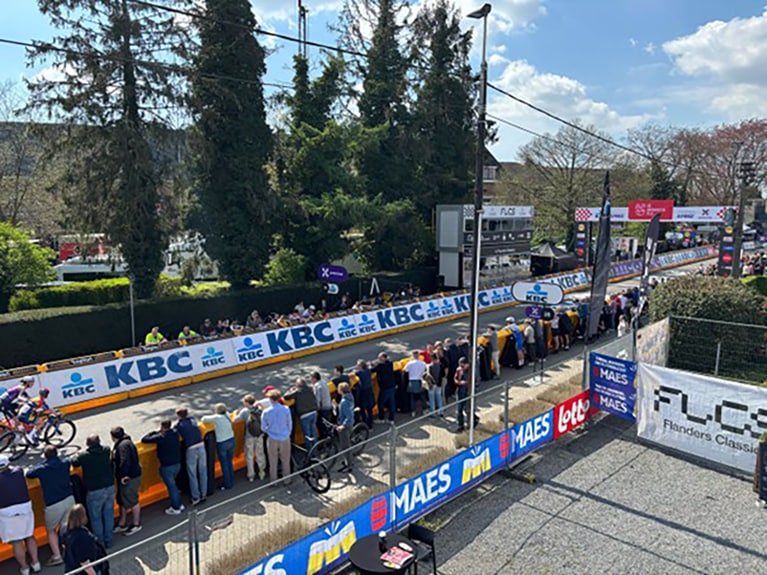
Marnix: We were in the grandstands in the VIP section, and we could look over the crowd and see our team's rider come in over the finish line.
Thomas: When they went by, we cheered extra loud, of course. It is so cool to see your work meet the real world. It's like seeing your data pipeline live.
Sven: Our team were all cycling fans. It was a bit of a childhood dream to be there.
This team's goal, way back in the painful years after 2012, was not limited to winning. It was to write a whole new chapter for the sport.
Sven: Yes, that's right. And this could be that whole new era of cycling. We are really helping this team change the entire sport because other teams are seeing what Visma is doing and trying to copy it. The sport has evolved so much over the years—optimizing tactics, nutrition, training plans. Now, there's analytics and AI. Some say it's killing the tradition, but this is not about preserving the past. All these changes make cycling more competitive and more complex and more fun to watch. So, it's a win-win for everyone.
NOTE: The Dutch team recently won the Giro d'Italia using tactics based on the model that the CST built.

