
While athletes around the world were preparing for the Winter Olympics, an alumnus was gearing up for another elite event: the Microsoft Excel World Championship. If you think Excel is just rows and columns, you haven’t met Alexander Freedman (New York, 15-24). Now an Associate Partner at Ridgeline Health Group, Alexander spent nearly a decade at McKinsey building advanced modeling and problem-solving skills to tackle complex challenges in healthcare. Today, he puts those skills to the test in a new arena: Excel Esports.
He’s part of a rapidly growing international community of “Excel athletes” competing to solve Excel-based case studies under intense time pressure. Challenges range from analyzing messy datasets that mirror real-world analytics to solving intricate logic puzzles, often pushing beyond what most people think is possible in Excel. And the stakes are real: alongside the World Championship title, top competitors are vying for a $100,000 prize pool.
After breaking into the global top 30 in his first full season, Alexander has surged to #5 globally and #1 in the U.S., demonstrating how core consulting capabilities translate to performance under pressure. From McKinsey modeling to global competition, his journey shows how, with the right formulas, you can SUM up to world-class performance.
So, first question: can the Firm take any credit for your exceptional Excel skills?
Absolutely. It all started at McKinsey. I joined the Firm with no practical Excel experience, and on day one, my manager took away my mouse and said, “You won’t be needing this.”
That moment stuck with me. He drilled best practices into me from the start, becoming the first of many fantastic mentors I had at the Firm. Over time, I became the go-to person for analytics and modeling and eventually found myself teaching those same principles to others.
I spent nearly a decade at McKinsey, and it’s where I built the foundation of my skill set, both in healthcare strategy and in how to approach complex problems analytically. I can’t imagine a better environment to develop those capabilities.
Your mentor took your mouse? Why wouldn’t you need a mouse?
In Excel, using a keyboard is much faster and more efficient than using a mouse. When working across large datasets or building complex models, shortcuts save significant time, which adds up quickly.
In a competitive setting, that efficiency becomes even more important. You’re solving problems under intense time pressure, where every second matters. Mastering the keyboard lets you operate at a completely different speed.
It’s a small shift early on, but it fundamentally changes how you interact with Excel. Whether for Excel Esports or modeling financial impact, it’s one of the best ways to improve your skills.
Tell us about these competitions. How do they work?
The competitions are very similar to what we do in consulting. You’re given a time constraint, typically around 30 minutes, along with questions to answer and a dataset that’s often messy, incomplete, or spread across different formats.
From there, it’s about structuring the problem, building the right logic, and getting to an answer quickly and accurately. You need to think critically and execute efficiently under pressure.
What makes it unique is that there are countless ways you can approach a problem, and the competition rewards those who can get creative and find the most efficient path.
How did you get into this?
I first heard about the Excel World Championship while I was at McKinsey, when a client mentioned it in passing. My teammates encouraged me to check it out. At the time, I didn’t think much of it, but it stuck with me.
After leaving the Firm, I decided to take a closer look and try a few practice cases. Very quickly I realized how closely it aligned with the skills I’d been building.
It felt like a natural extension of my consulting work, just in a more competitive and fast-paced setting. Once I got into it, I was hooked.
That’s so cool. How many people take part in the competitions?
There are over 2,000 competitors globally, representing more than 50 countries, with strong representation from top consulting, accounting, and other professional service firms. The player pool is also growing quickly.
Not everyone competes at the same level, but there’s a few hundred highly active participants who compete regularly throughout the year, all working toward qualifying for the World Championship in Las Vegas each December.
It’s a very international and increasingly competitive field, which makes the progression and rankings even more meaningful.

How have AI tools affected your use of Excel?
I mostly use AI around Excel rather than inside it. It’s helpful for structuring problems, exploring possible approaches, and pressure-testing ideas.
For newer users, AI can also be a great learning tool. But it’s still important to build your own pattern recognition and analytical thinking. AI can make you faster, but it doesn’t replace understanding the logic yourself.
I’m assuming that, like the rest of us, you keep your holiday card and gift lists in Excel. How else do you use it in your personal life?
I use it all the time for personal finance, travel planning, exercise tracking, and organizing competitions or games with friends. Some of my most-used spreadsheets date back 5 or 10 years and are still part of my daily routine.
Okay, spill it. What’s your favorite Excel tip or trick?
This might sound controversial, but no one should be using VLOOKUP. Instead, use INDEX MATCH or XLOOKUP. They’re much more flexible and better suited for Excel.
What do you like to do when you’re not serving clients or competing in Excel Esports?
First and foremost I love spending time with my friends and family. I’m also very into fitness and running, and I’m currently training for the New York City Marathon.
I’m a huge sports fan – Mets, Jets, and Knicks – and I followed the Olympics closely this year. I really admire the dedication that the athletes bring; seeing them give their all motivates me to do the same in my own pursuits.
Do you get nervous?
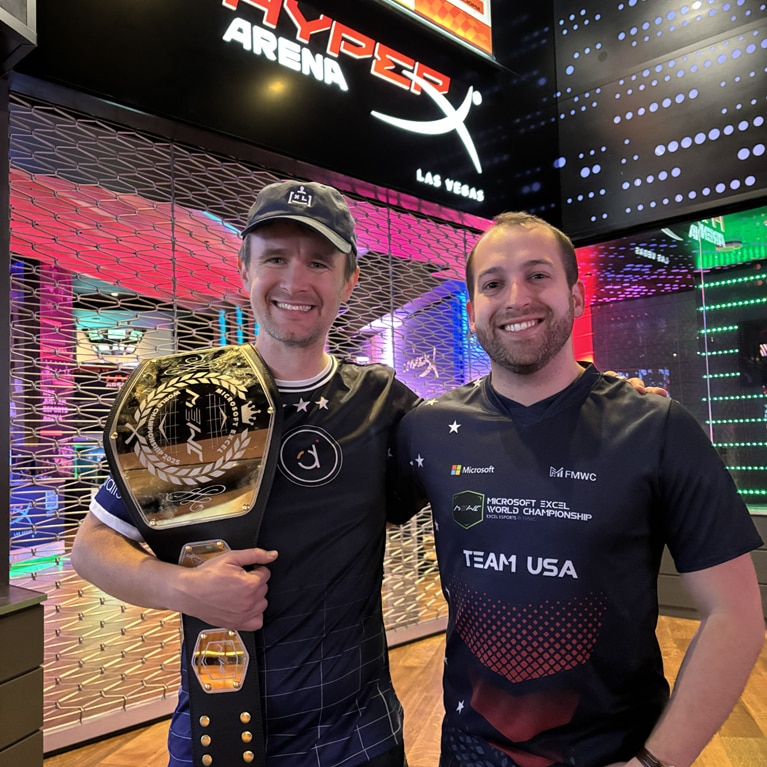
Competitions typically last half an hour, with a short preview beforehand. It’s a compressed format, so preparation matters a lot.
There are definitely nerves that are similar to going into a big meeting, exam, or competition, but that’s part of what makes it fun. I usually do a few warm-up exercises and try to get into the right headspace beforehand. Once the case starts, it becomes all about focus and execution.
This has been fascinating. Is there anything else that we should know?
The competition is still relatively new in its current form, but it’s growing quickly and attracting a truly global community. That’s part of what makes it so exciting: it still feels early. It has attention from Microsoft leadership as well.
There’s also a documentary in production about the competition. I was fortunate to be involved in filming, and it’s expected to begin release through festivals later this year.
And for anyone reading this who wants to put their skills to the test, I’d absolutely encourage you to check it out. I’d love to see even more McKinsey representation on the leaderboards.
We’ll definitely go and see it. Keep us posted!
Thanks – I will!

