
Sabeena Ladha (San Francisco, Southern California 16-18) is the founder and former CEO of DEUX Foods, a better-for-you snack company known for its plant-based, nutrient-rich cookie doughs and other indulgent-but-healthy treats. She launched DEUX in 2020 to merge wellness with fun, nostalgic snacking. Sabeena quickly gained recognition for her bold, playful marketing and her mission to make healthier foods feel exciting and accessible.
In this interview, Sabeena – who’s currently an independent consultant working on growth strategy with several startups – talks with us about the biggest risk she ever took, how a values-ranking exercise proved to be a turning point, and why she’s happy in the current moment.
What was the original spark that inspired you to create DEUX Foods and what gap in the food market were you trying to fill?
Originally, I wanted to essentially remake nostalgic classics. I am from a small town in Texas and I grew up on what I call the standard American diet – you know, all the typical stuff that we ate as kids, like macaroni and cheese and packaged cookies. Then in college, I discovered the wellness world and I was experimenting with juice cleanses and getting certified to teach Pilates, and reversing the effects of the food that I ate growing up.
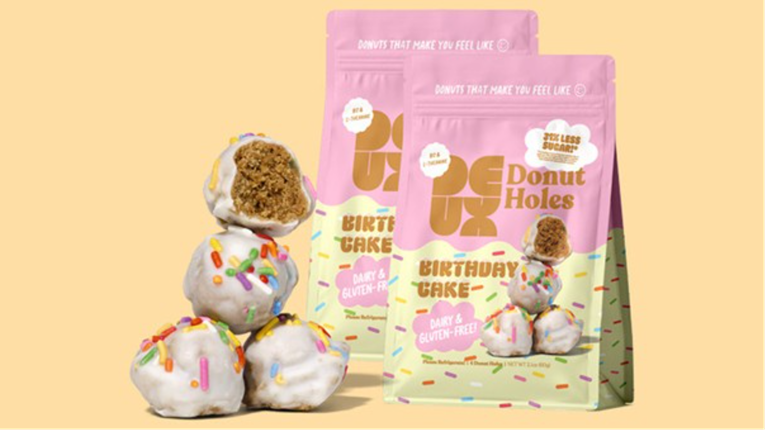
I had a craving, no pun intended, for creating something that tasted delicious, but that had a lower sugar content, was better for you, and that had clean ingredients. The biggest gap I found was that the food that was made that way didn’t always taste great. So the question for me was, could I develop flavors that tasted delicious? Could I make it clean and better for you without sacrificing taste? And that, I think, is what we did best with our cookie dough products and our donut products. I was inspired by going up against the big CPG companies, but also by simply trying to improve on the formulas that consumers really love.
What would you say was the biggest risk that you took early on and how did it pay off (or not)?
The biggest risk I ever took also turned into an opportunity: going on Shark Tank. It was a risk in two ways. First, it's a huge time commitment, especially if you’re a solo founder. There’s about 100 hours of work that goes into a Shark Tank appearance. You're working with producers, you’re developing and practicing your pitch, but there's so much more than that on the business side that you have to work with their team on. You do rounds and rounds of videos to perfect it. So you’re subtracting that amount of time from time working on your business. And even then, once you film, and go through that whole process, you still only have a 50% chance of getting on air.
It's also a risk in that you don't know how your episode will be cut or perceived. We ended up with 45 or 50 minutes on film, but you get cut down to probably a six-minute segment. I remember watching and there was one question that they asked that was clipped to a different answer. So it's risky in that sense.
My episode was pretty polarizing for some reason. A lot of people really loved the female-empowerment message, but then other people thought I should have taken the original deal and they were upset by that. I got some backlash online when it aired. There were comments about my outfit and what I looked like. There was a headline that said, “Entrepreneur Pitches to Mark Cuban in Pink Suit and Kitten Heels.” I addressed those issues online, and it started this snowball of addressing women being treated differently in business. It ended up being a good thing because we got a ton of press out of it and it was, but at the time, I remember being like, oh no, what did I just do?
So you turned it around the negative chatter and took control of the narrative.
Yes. That’s the good part about the internet as well, right? It's a little bit scary sometimes, but you can also have a voice, which is great.
So that's one thing you faced as a female founder that male founders most likely would not have faced. Are there any other obstacles that you faced as a woman founder that you weren't expecting?
I actually would say there was a lot of opportunity that I wasn't expecting. In 2020, when I launched, there was a lot more focus on diversity and on female entrepreneurs and how women at that time were only getting 2% of all VC funding. 98% of funding was going to men, which is kind of nuts when you think about it. So in the atmosphere at the time, retailers and consumers were willing and had a desire to support women entrepreneurs.
Whole Foods was and is such a great partner for us. We initially launched in one region and then we went national, and they did a founder spotlight on me. On every refrigerator with our product they had a big sticker display of my story and what DEUX was all about. That spotlight really helped get the word out. I'm really grateful for things like that. So that’s all to say that a lot of opportunities like that came up that I really appreciated, because people were realizing that women were so underrepresented.
That's so great. Are you working on anything else right now?
I am taking my chops to consulting, but I'm doing it independently. I have a network of founder friends and an entrepreneurial venture-backed community. I would say what we did best at DEUX was to break the Internet. We were pretty brand-forward, and we were known for our marketing.
When I was at McKinsey, I was in what was at the time the Marketing and Sales practice, and that’s the function that gives me the most energy. I am currently consulting with three brands that are all in the growth stage: one in the supplement space, another that’s an olive oil brand, and another that’s a natural deodorant brand. They’re all direct-to-consumer, and I'm helping with a variety of different things on the growth side. It’s been really fun to get the variety. Basically, I married my McKinsey background and skills with my startup experience and now I'm doing something at the center of both.

Is there a moment you can point to as a critical turning point in your life?
I once had to do a values exercise, where I had to stack rank my values. You’re given 50 values, and you pick your top five and your bottom five. You never think of your values in that way, so it was an interesting exercise. In my top five values, my number one, above anything, even family, was achievement. It was an emotional experience for me because I didn’t love that achievement drives me so much.
I had kind of an existential crisis about that. It allowed me to pull back and figure out, why is that my number one value? With DEUX, I was so focused on things like, how do I get to $10 million in revenue? How do I get the next retailer open? Founding DEUX was the biggest lesson in that, because every time you hit that next thing, it isn’t as satisfying as you thought it would be. It still feels good, but you think it would have felt more groundbreaking. But what really felt the best was things like the team having a fire drill and staying up all night because we had to fix something, and laughing and having a beer. That is actually the joy of it, versus hitting a milestone.
What would you say to someone who is thinking about joining McKinsey?
I still tell people to do it. I tell people McKinsey is my favorite job I’ve ever had, and I include Deux in that. There’s a number of reasons for that, but it’s an amazing place to be, whether it's for two years or for 20 years. I have such confidence that new joiners are going to have a good experience and that they will come out of there with so much great experience. It’s like dog years. You go in, you get two years of experience at McKinsey and it's equal to 10 years anywhere else in the corporate world. There's no place else like it. There just isn't.
Is there a particular book or film or piece of art or music that has been on your mind lately?
There’s an Apple TV show called “Your Friends and Neighbors” that I think is quite good. At the beginning of that show, the main character does this monologue about keeping up with the Joneses. And my husband (also a McKinsey alum) and I sat there in dumbfounded silence because the monologue really hits a high achiever's heart. We’re all in a rat race and we all just want more. And you get more, and then you still want more. It did it in an entertaining way that was poking fun at it, but it forced us to have a conversation about when is enough enough? We realized that we are so grateful for what we have now, and we both said that if our lives stayed like this, we would be completely and utterly satisfied. We have a baby that we are obsessed with. We’re both working on things that we're super-passionate about. Sure, we have issues that come up in our lives, but we're so grateful in the moment.

